
The answer so far
There is no established rule that everyone taking vitamin D3 also needs K2. Both have roles in the body, but that does not prove the combination is necessary or prevents heart disease. Vitamin K can interfere with warfarin and similar medicines, so check the exact product with the clinician managing your treatment.2
On this page
Do you need vitamin K2 with vitamin D3? Choose a step to explore this subject in more detail.
Why are D3 and K2 sold together?
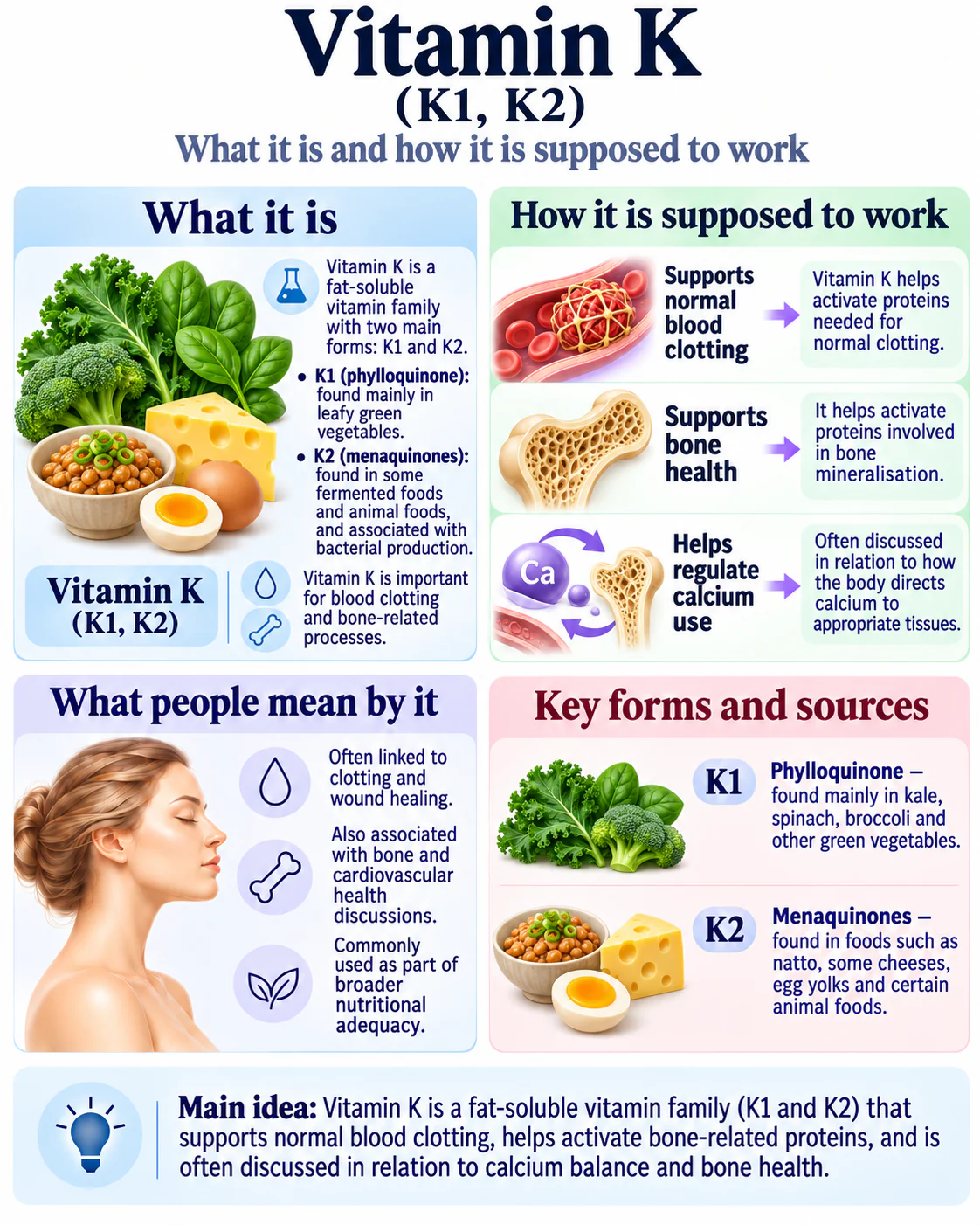
Vitamin D helps the body absorb calcium. Vitamin K supports proteins involved in blood clotting and bone. Researchers are also studying a vitamin K-dependent protein involved in calcium buildup in blood vessels. K1 and K2 are related forms; K2 includes forms such as MK-7.2
These roles are reasons to study combinations. They do not prove that taking D3 alone sends calcium into arteries or that everyone needs a K2 supplement. Getting vitamins in food, treating a deficiency and testing a supplement claim are different questions. See the vitamin D profile.
Illustrations
Vitamin K can interact with warfarin; this simplified image is not medication advice.
 Open image at full size
What do the trials actually show?
The 2022 AVADEC trial assigned 365 men aged 65–74 with substantial calcium buildup in the aortic heart valve to a K2-and-D combination or placebo for two years. It found no statistically significant difference in progression of valve calcification. The confidence interval included both slower and faster progression with the combination, so the result does not prove there was no effect.3
The 2026 DANCODE trial assigned 400 people with severe calcium buildup in coronary arteries to K2 plus D3 or placebo for two years; 398 were included in the reported analysis. Their median age was 71, and 30% were women. The CT calcium score increased in both groups: by an average of 196 points with the combination and 248 with placebo. The reported difference was 52 points less with the combination, with a 95% confidence interval of 24 to 79 points less. That describes uncertainty around the group difference, not an individual prediction. It was a smaller increase, not evidence that existing calcium was removed.4
These trials studied different people and scan measures. Neither proves the combination prevents heart attacks or applies to everyone taking D3. DANCODE compared the combination with placebo, so it cannot establish whether K2 adds a benefit to D3 alone. Its published protocol excluded people taking vitamin K antagonists and planned withdrawal if they needed one during the study. It therefore does not establish that K2 is safe with warfarin or similar medicines.341
Kappa, a K2 producer, funded DANCODE. Kappa Bioscience and Orkla Care supplied the AVADEC tablets.34
What about bones?
Vitamin K has a role in normal bone metabolism. The US National Institutes of Health describes mixed trial results and says it is unclear whether vitamin K supplements reduce osteoporosis risk. Bone-density measurements and fractures are different outcomes. Some studies give K with D or calcium while the comparison group does not, making it harder to isolate K’s effect. Taking vitamin D for a documented need is a separate decision from taking extra K2. Neither trial above settles whether fractures are prevented.2
Can K2 change an anticoagulant blood test?
Yes, for medicines called vitamin K antagonists. In a small 2013 study, 18 healthy volunteers received acenocoumarol, one such medicine. Fifteen reached the study’s target clotting-test range and were then given increasing amounts of MK-7, a form of K2. Researchers observed reductions in INR, a blood test used to monitor these medicines.6
This short volunteer study was not a trial in people taking warfarin and does not show that a particular K2 amount is safe. It illustrates why the clinician managing anticoagulation should review any proposed K2 supplement.
Warfarin and other practical questions
Vitamin K can seriously affect warfarin and similar medicines called vitamin K antagonists. Sudden changes in vitamin K from food or supplements can change their effect. This does not mean you must avoid foods containing vitamin K. NHS guidance says people taking warfarin can still eat foods such as greens; consistency and discussing major changes with their anticoagulation team matter.25
The same food restrictions do not usually apply to direct oral anticoagulants such as apixaban, but other interactions are possible. Ask about your exact medicine and product. Vitamin D can also cause harm in excess. Vitamin D supplements taken with thiazide diuretics may cause high blood calcium; this risk is especially relevant for older adults and people with impaired kidney function or hyperparathyroidism. Ask a clinician or pharmacist about your medicines and vitamin D. Check labels for repeated ingredients, and do not change a prescribed medicine on your own. See supplement and medicine interactions.57
Further reading
Trusted external resources selected to help explain this page. They open in a new tab.
- Vitamin K: Health Professional Fact Sheet ↗US evidence summary: vitamin K forms, bone and warfarin.
- Vitamin K2 and D in Patients With Aortic Valve Calcification: A Randomized Double-Blinded Clinical Trial ↗Randomised trial measuring heart-valve calcification in older men.
- Vitamin K2 and D3 Supplementation in Patients With Severe Coronary Artery Calcification: The DANCODE Trial ↗Randomised trial in severe coronary calcification; scan results are not heart-attack outcomes.
Sources, kept close.
Selected supporting sources; this is not a complete literature review.
- Effects of vitamins K2 and D3 supplementation in patients with severe coronary artery calcification: a study protocol for a randomised controlled trialBMJ Open · Published study protocol
- Vitamin K: Health Professional Fact SheetNIH Office of Dietary Supplements · US scientific evidence summary on vitamin K, bone, calcification and interactions
- Vitamin K2 and D in Patients With Aortic Valve Calcification: A Randomized Double-Blinded Clinical TrialCirculation / PubMed · 2022 Danish randomized trial of aortic-valve calcification in 365 men
- Vitamin K2 and D3 Supplementation in Patients With Severe Coronary Artery Calcification: The DANCODE TrialCirculation / PubMed · 2026 Danish randomized trial of coronary calcification in 400 participants
- Anticoagulant medicines: considerationsNHS · UK public medicine information
- Effect of low-dose supplements of menaquinone-7 on the stability of oral anticoagulant treatmentJournal of Thrombosis and Haemostasis / PubMed · Small human anticoagulation study, 2013
- Vitamin D: Health Professional Fact SheetNIH Office of Dietary Supplements · Official nutrition evidence summary; United States