
The answer so far
Vitamin D helps the body absorb calcium and supports healthy bones. Treating a deficiency is different from taking supplements to prevent other illnesses. US National Institutes of Health summaries do not support vitamin D supplements for weight loss; prevention trials have also not shown an overall reduction in depression or cardiovascular disease with routine supplementation.3
On this page
Before you read the detail
What it is
A nutrient that helps regulate calcium and phosphate and supports healthy bones; deficiency treatment differs from routine prevention supplements.3
What human evidence shows
Prevention trials found no overall reduction in cardiovascular disease, fractures or depression in studied groups; correcting deficiency is a separate question.457
Main cautions
Excess vitamin D can be harmful, and blood-test results need clinical context.6
Current status
Recommendations depend on country, age, feeding situation and health context.2
A nutrient with a specific job
The body processes vitamin D from food, sunlight or supplements into active forms. One of its clearest roles is helping regulate calcium and phosphate for healthy bones. Researchers are also interested in immunity, mood and metabolism, but a possible role in the body does not prove that supplements prevent or treat those conditions.3
For practical questions, see vitamins and food, supplement interactions, storing vitamins and minerals, and vitamin D3 and K2.
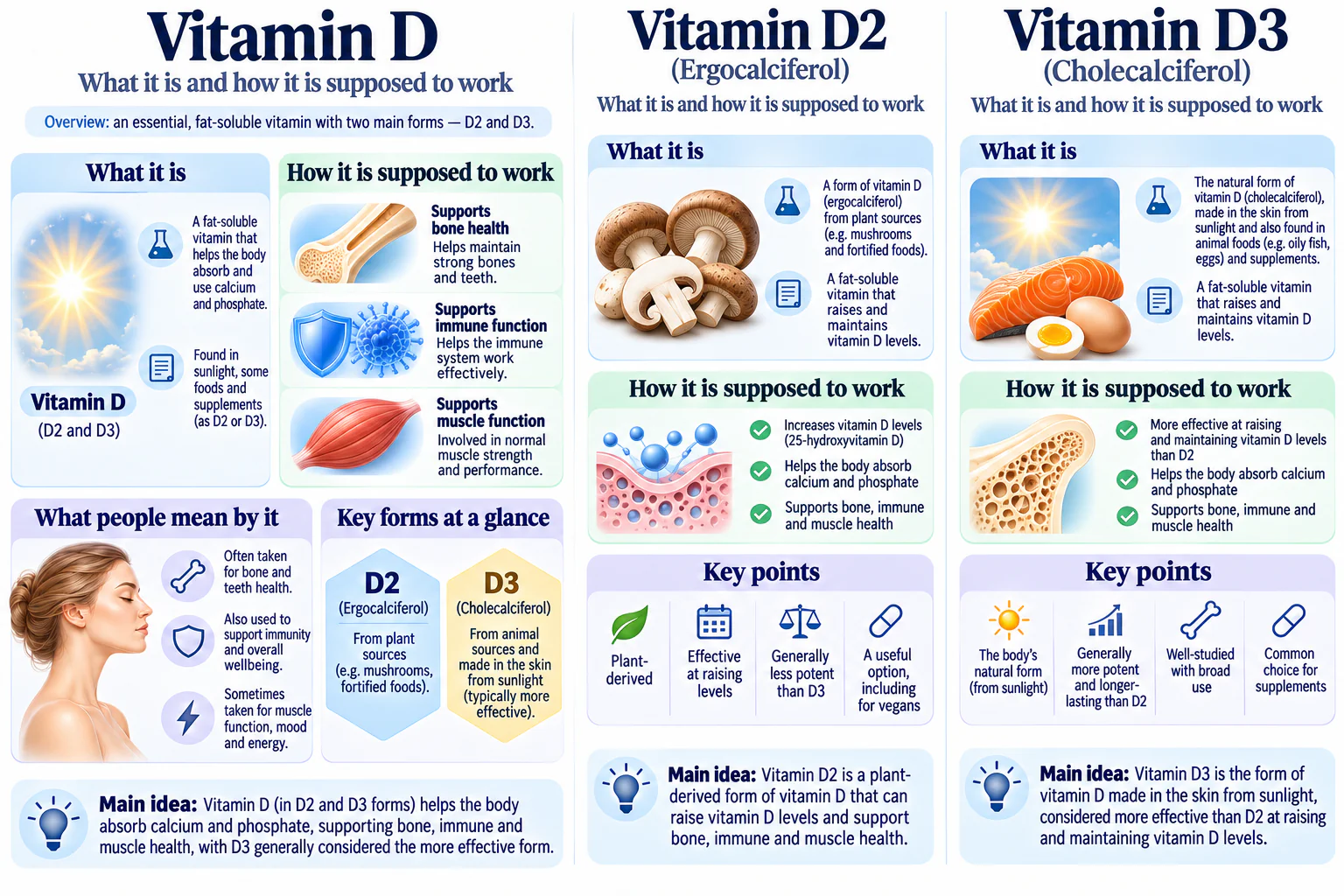
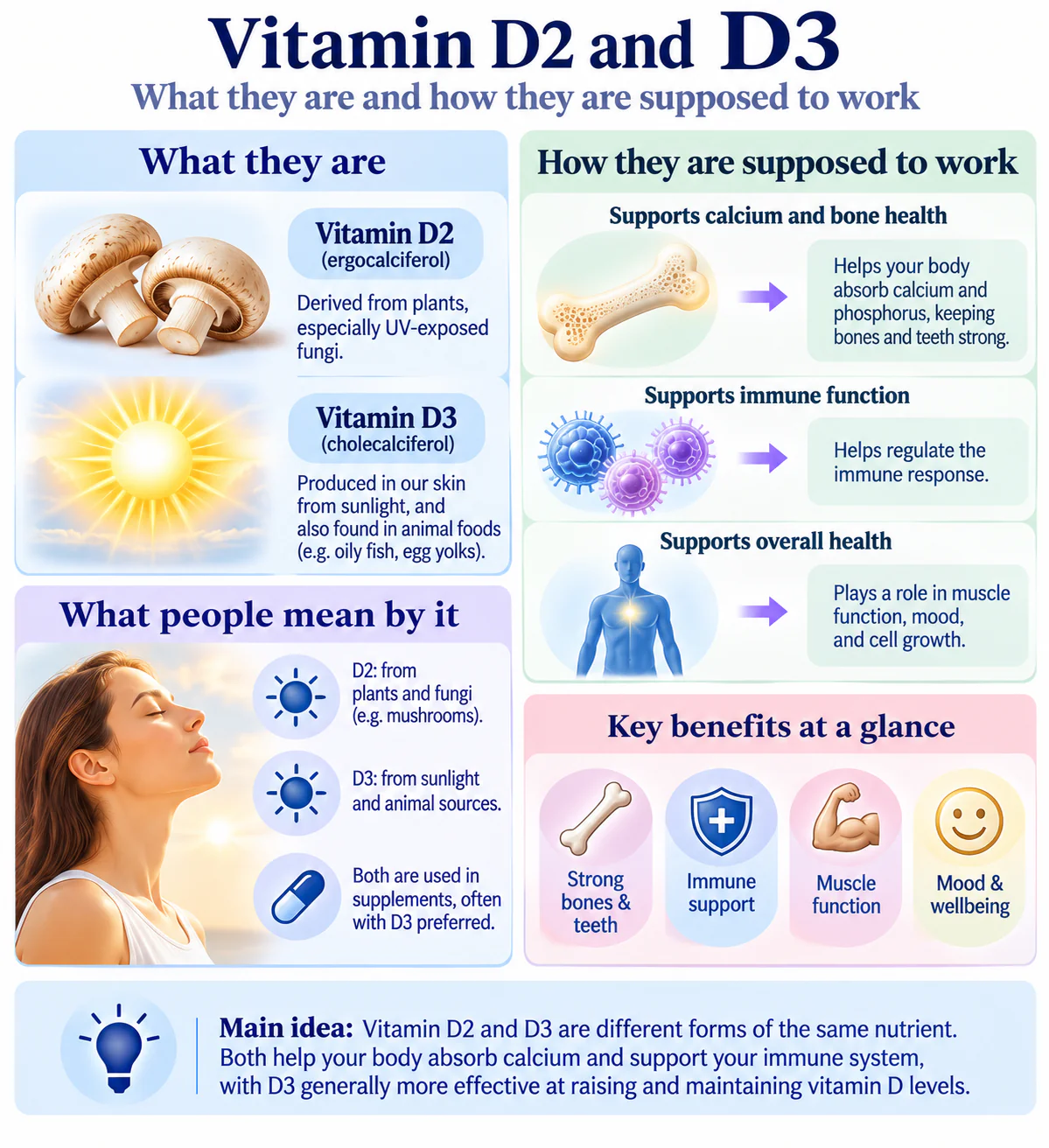
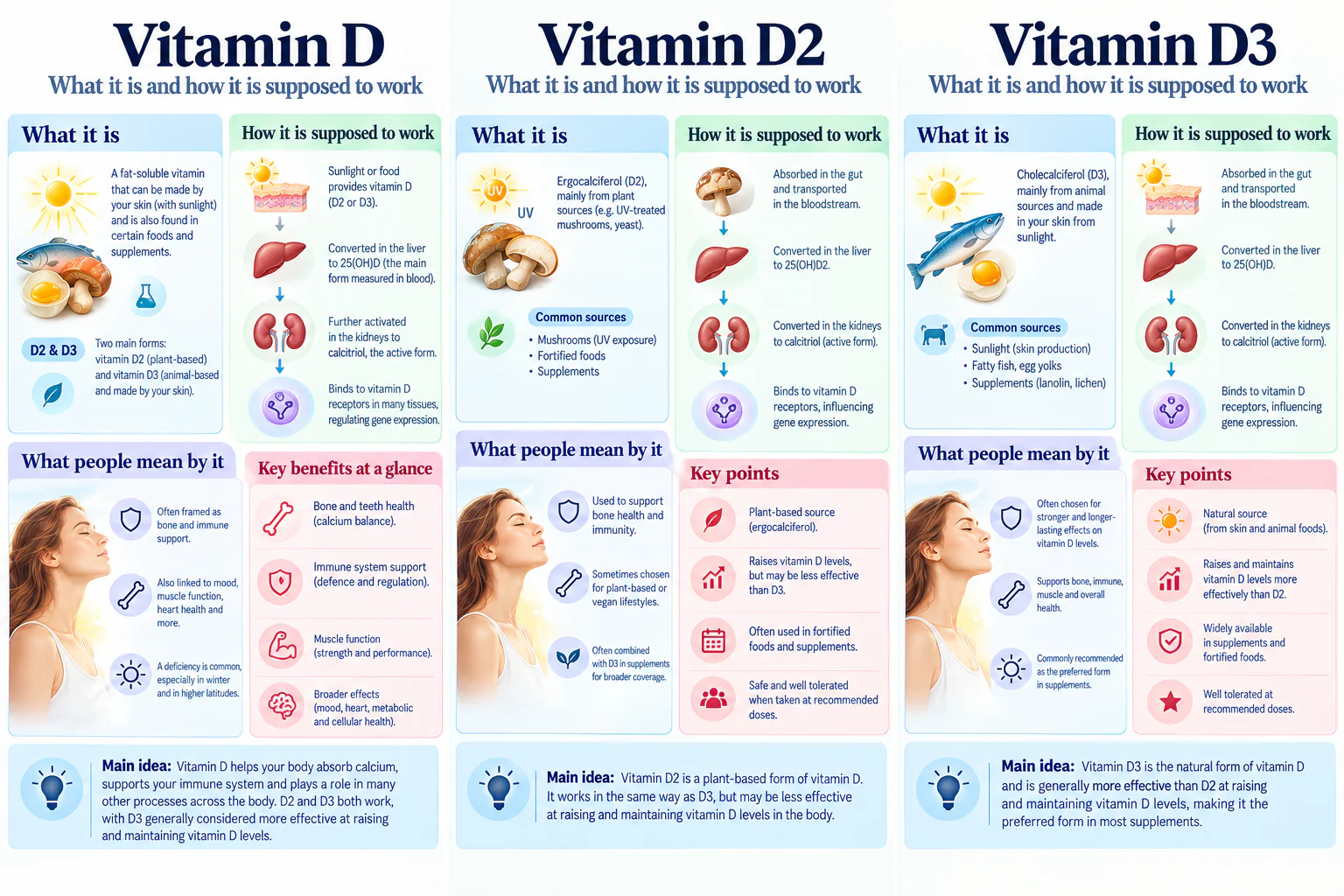
The illustrations compare two forms of vitamin D. D2 can come from UV-exposed mushrooms and fortified foods; D3 is made in skin exposed to sunlight and occurs in foods such as oily fish and egg yolks. Some D3 supplements come from lichen. Both forms are processed first in the liver and then mainly in the kidneys to active forms. D3 may raise blood 25(OH)D more and for longer than D2; that measurement alone does not establish better mood or other health outcomes. The pictures show normal roles in bone, muscle and immune function, not proof that extra supplements improve these outcomes for everyone.3
Read the image summary
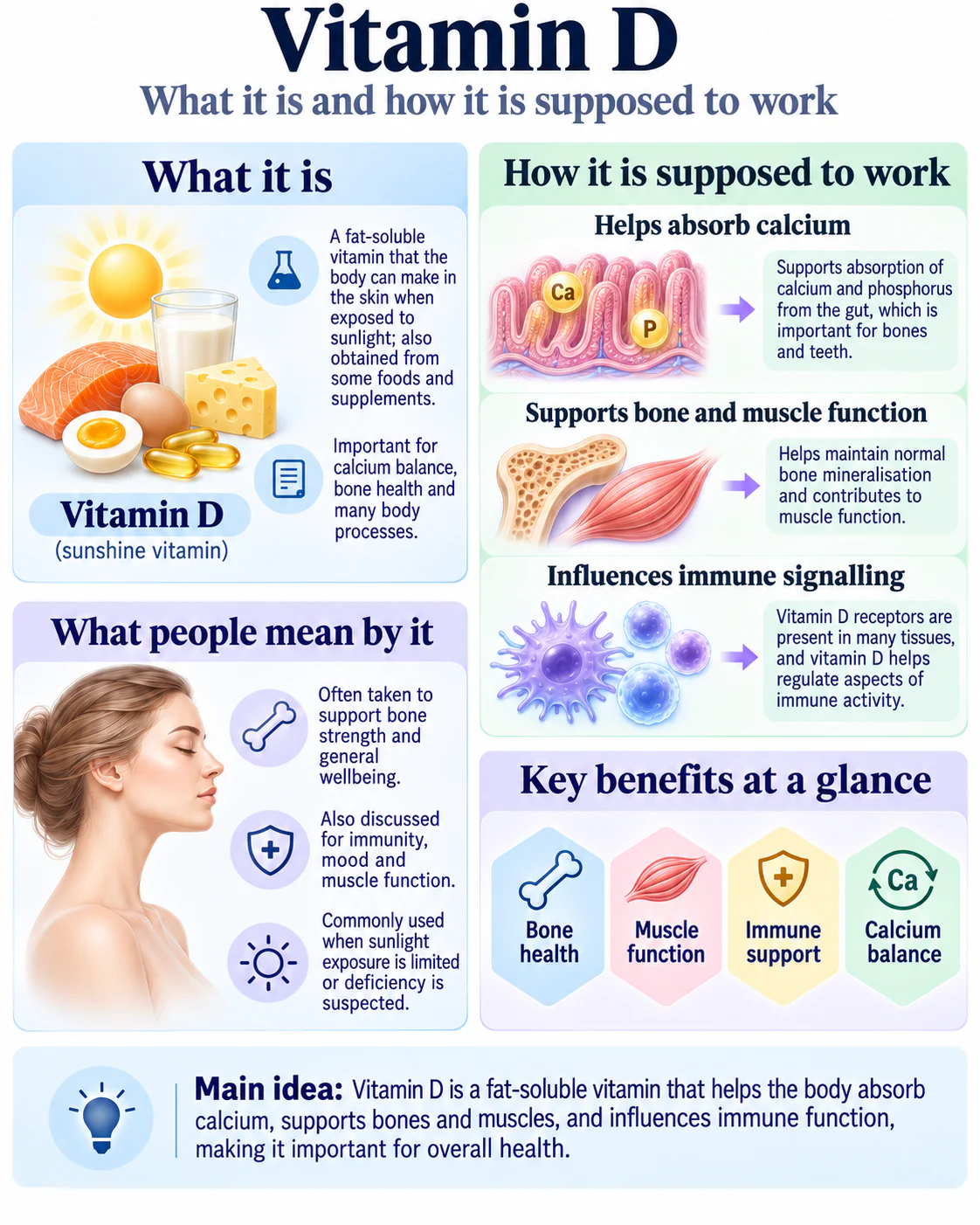
Vitamin D is a fat-soluble vitamin made in the skin after sunlight exposure and obtained from some foods and supplements. It helps the gut absorb calcium, supports bone mineralisation and muscle function, and has a role in immune signalling. The image also describes reasons people take vitamin D; those reasons do not establish that supplements prevent disease.
Illustrations
D2 and D3 have different active metabolites; D3 can also come from lichen. Broader supplement benefits remain uncertain.
 Open image at full size
D2 and D3 have different active metabolites; D3 can also come from lichen. Broader supplement benefits remain uncertain.
 Open image at full size
D2 and D3 have different active metabolites; D3 can also come from lichen. Broader supplement benefits remain uncertain.
 Open image at full size
What evidence supports
Correcting deficiency can prevent problems such as rickets in children or osteomalacia in adults. For people without deficiency, large prevention claims need to be tested in trials. NIH summaries report no meaningful weight-loss effect and no overall reduction in cardiovascular disease from routine supplements. For how nutrient adequacy relates to infection-prevention claims, see the immune-support guide.3
What about babies? UK NHS guidance recommends a daily vitamin D supplement containing 8.5–10 micrograms for babies who are fully or partly breastfed from birth to age one. Babies having more than 500 mL of infant formula a day should not be given extra vitamin supplements under that guidance, because formula is fortified. Another NHS page says 500 mL or more; ask a health visitor or clinician about the exact boundary and mixed feeding. Recommendations differ between countries and feeding situations, so ask your baby’s clinician or health visitor about the appropriate product and amount. Check the label and avoid giving overlapping vitamin products without advice.15161
National references differ. The UK NHS says adults and children aged one and older need 10 micrograms (400 IU) of vitamin D a day, including during pregnancy and breastfeeding. For adults and children over four, the NHS says to consider a daily supplement in autumn and winter; it recommends year-round supplements for children aged one to four and some people with limited sun exposure, and advises other at-risk groups to consider them. The US recommended dietary allowance is 15 micrograms (600 IU) for ages 1–70 and 20 micrograms (800 IU) above age 70; it assumes minimal sun exposure. These are population references, not doses for treating a deficiency. Local supplement guidance depends on age, season, sun exposure and circumstances; ask a clinician about individual needs.6202122
People with conditions that limit fat absorption, such as coeliac disease, Crohn’s disease or some liver conditions, and people with obesity or previous gastric-bypass surgery may be more likely to have low vitamin D status. Their supplement or testing needs can differ; ask a clinician rather than assuming a standard over-the-counter dose applies.6
Does vitamin D prevent fractures or serious disease?
The US VITAL trial randomly assigned 25,871 adults to vitamin D3 or a placebo. It included men aged 50 or older and women aged 55 or older. Participants were followed for a median of about five years.4
Vitamin D did not significantly reduce invasive cancer or major cardiovascular events. A later analysis also found no overall reduction in fractures. Participants were not selected because they had vitamin D deficiency, low bone mass or osteoporosis. The results do not show that treating a deficiency is useless, or settle care for people with those conditions. The trial tested a particular supplement in a particular group.45
For the actual cancer and fracture counts, see can vitamin D supplements prevent disease?.
What does a vitamin D blood test measure?
The usual test measures 25-hydroxyvitamin D, often written 25(OH)D. It helps assess vitamin D status, but the result needs context. Laboratories and expert groups can use different methods and thresholds, and a low result does not by itself explain every symptom. Diet, absorption, limited sun exposure and other factors can affect the chance of deficiency. A clinician can help you decide whether testing or supplements are appropriate.610
Does everyone need a test? No. MedlinePlus says routine testing is not recommended for everyone. In 2021, the US Preventive Services Task Force found insufficient evidence to judge the benefits and harms of screening nonpregnant adults living in the community who have no symptoms. That uncertainty does not mean testing is useless for someone with symptoms or a relevant condition.1011
Check the units before comparing results. Labs may use nanograms per millilitre (ng/mL) or nanomoles per litre (nmol/L). For example, 20 ng/mL and 50 nmol/L describe the same concentration. The conversion does not tell you whether the result is appropriate for you; discuss it in context.6
As a population guide, the US National Academies’ Food and Nutrition Board associates 25(OH)D below 30 nmol/L (12 ng/mL) with deficiency; 30 to below 50 nmol/L (12 to below 20 ng/mL) may be inadequate for some people. It considers 50 nmol/L (20 ng/mL) or more adequate for most healthy people, while levels above 125 nmol/L (50 ng/mL) can be associated with adverse effects. These are not universal diagnostic cutoffs or individual treatment targets; discuss your result and circumstances with your clinician before changing supplements.6
A different test measures 1,25-dihydroxyvitamin D, the active form. It is not usually used to assess vitamin D status because its level is tightly regulated. Clinicians may use it for specific questions, such as kidney problems or abnormal calcium. The two results are not interchangeable.610
Does vitamin D prevent depression or improve mood?
A low vitamin D blood level and depression can occur together, but that association does not show that one caused the other or that a supplement will improve mood. Prevention and treatment are different questions.6
In the US VITAL depression study, 18,353 adults aged 50 or older without clinically significant depressive symptoms at the start were assigned vitamin D3 or placebo. Over a median 5.3 years, the researchers found no statistically significant difference in new or recurrent depression or clinically relevant symptoms, or in average mood-score changes. This does not establish whether treating a confirmed deficiency helps a particular person.7
A Finnish trial published in 2026 followed 2,434 older adults, largely with sufficient vitamin D, assigned one of two vitamin D3 groups or placebo. During the five-year supplementation period, relatively few participants developed diagnosed major depression and neither supplement group differed significantly from placebo. The authors reported a possible signal in longer follow-up, but its uncertainty and small event counts mean it needs confirmation.8
Studies of people who already have depression or significant symptoms ask a treatment question instead. A 2026 review found an encouraging but highly variable signal across some vitamin D-containing interventions; differences in populations and products limit confidence about who might benefit, and the review could not establish an added benefit from particular combinations of nutrients. Neither prevention trials nor these mixed treatment findings justify replacing mental-health care with supplements. A clinician can assess symptoms and whether testing or correcting a deficiency is appropriate; excess vitamin D can be harmful.9
Too little and too much
Vitamin D deficiency can harm bones and muscles. Excess from supplements can raise blood calcium and cause harm, including kidney problems. Vitamin D produced through sun exposure does not accumulate to toxic levels in the same way, but ultraviolet exposure increases skin-cancer risk; follow local sun-protection guidance. The US upper intake level for adults is 100 micrograms (4,000 IU) a day from food, drinks and supplements combined. This is an upper limit, not a target or a guarantee of safety for every person; limits for younger children are lower. A clinician may prescribe a higher dose temporarily for deficiency. Product strength, other supplements, medical conditions and medicines all change the context, so this page does not give an individual dose.236
Too much vitamin D can lead to high calcium, which may cause nausea, vomiting, unusual thirst, frequent urination or weakness. These symptoms have other possible causes and do not diagnose toxicity. If you or a child may have taken too much, seek prompt advice from a clinician or local poison service and have the product packaging available; do not wait for symptoms. A clinician may prescribe a higher-strength vitamin D course for a limited time to treat deficiency. Follow the individual prescription and ask the prescriber or pharmacist if the dose or duration is unclear, rather than adding extra products or changing it yourself.6
Can medicines or other supplements change the question? The US NIH says orlistat, together with a reduced-fat diet, can reduce vitamin D absorption from food and supplements. The US Xenical prescribing information separately says its effect on absorption of supplemental vitamin D is unknown. A 2013 review found insufficient evidence to determine the drug’s effect on blood vitamin D levels: in two randomized studies, levels also fell in the comparison groups. Another randomized trial published in 1999 reported a greater fall in average blood vitamin D with orlistat than placebo, but many participants did not complete the study; it did not directly measure absorption of a vitamin D supplement. This uncertainty does not prove there is no interaction. Some diuretics, including thiazides, can increase the risk of high blood calcium when used with vitamin D; the risk can be greater in people with kidney problems or certain other conditions. Vitamin D and calcium may also appear in more than one product. Show a pharmacist or clinician the actual medicines and supplement labels before adding or changing a product, and do not stop a prescribed medicine yourself. For a separate effect of orlistat on another nutrient, see vitamin A and medicine interactions.12171819
The US NIH also notes that corticosteroids such as prednisone can reduce calcium absorption and impair vitamin D metabolism. High vitamin D intakes may reduce the effect of some statins. These possibilities do not mean every person will experience an interaction or should change a prescribed medicine; discuss the particular medicines and supplements with a clinician or pharmacist.6
Storage and the product label
Labels may give vitamin D in micrograms (mcg or µg) or international units (IU). For vitamin D, 1 microgram equals 40 IU, so 10 micrograms equals 400 IU. This is a conversion, not a recommended dose; it is also different from the units used for a blood test. Check the serving size, amount per serving and any other products containing vitamin D.6
Products may contain vitamin D2 (ergocalciferol) or D3 (cholecalciferol). Both raise vitamin D in the blood; D3 may raise it more and for longer. That does not mean everyone needs to change a prescribed product. D3 can come from lanolin or lichen, and other ingredients vary. If you avoid animal-derived ingredients or have an allergy, check the exact product and ask a pharmacist or manufacturer. Some colecalciferol products contain gelatine or may not be suitable for someone with a peanut or soya allergy.61314
Storage instructions differ between capsules, gummies and liquids. Check the package and see storing vitamins, sunlight and heat, and expiry and changes in appearance.
Further reading
Trusted external resources selected to help explain this page. They open in a new tab.
- NIH ODS: Vitamin D consumer fact sheet ↗
- Vitamin D supplements and prevention of cancer and cardiovascular disease ↗A randomised comparison in US adults, not a trial of treating diagnosed deficiency.
- Supplemental vitamin D and incident fractures in midlife and older adults ↗Participants were not selected for deficiency, low bone mass or osteoporosis.
Sources, kept close.
Selected supporting sources; this is not a complete literature review.
- Your baby's first solid foodsNHS · UK infant feeding and vitamin advice
- How and when to take colecalciferolNHS · UK patient medicine guidance
- Vitamin D — ConsumerNIH Office of Dietary Supplements · Official consumer fact sheet
- Vitamin D Supplements and Prevention of Cancer and Cardiovascular DiseaseNew England Journal of Medicine · Randomised placebo-controlled trial; United States; 2019
- Supplemental Vitamin D and Incident Fractures in Midlife and Older AdultsNew England Journal of Medicine · Randomised trial fracture analysis; United States; 2022
- Vitamin D: Health Professional Fact SheetNIH Office of Dietary Supplements · Official nutrition evidence summary; United States
- Effect of Long-term Vitamin D3 Supplementation vs Placebo on Risk of Depression or Clinically Relevant Depressive Symptoms and on Change in Mood ScoresJAMA / PubMed · Randomized prevention trial
- Vitamin D supplementation and incidence of major depressive disorder - A randomized clinical trialClinical Nutrition / PubMed · Randomized prevention trial; abstract
- Vitamin D-containing supplementation and depressive symptom severity in adults: A Bayesian systematic review and evidence-structure assessmentPubMed · Systematic review and meta-analysis; abstract
- Vitamin D TestMedlinePlus / US National Library of Medicine · Patient medical test reference
- Vitamin D Deficiency in Adults: ScreeningUS Preventive Services Task Force · US screening recommendation, 2021
- Taking colecalciferol with other medicines and herbal supplementsUK National Health Service · Patient guidance for colecalciferol
- Choosing vitamin D products for vegetarians or vegansNHS Specialist Pharmacy Service · UK professional medicines guidance
- Who can and cannot take colecalciferolNational Health Service · UK patient medicine guidance
- Vitamins for childrenNHS · UK public guidance for infant and child vitamins
- Vitamins for babiesNHS · UK public guidance on infant vitamin D
- XENICAL (orlistat) capsules: US prescribing informationDailyMed / US National Library of Medicine · US product label for Xenical 120 mg capsules; revised September 2026; DailyMed version 3 November 2026
- Drug–vitamin D interactions: a systematic review of the literatureNutrition in Clinical Practice · Systematic review, 2013; literature searched through September 2010
- Weight control and risk factor reduction in adults treated for 2 years with orlistat: a randomized controlled trialJAMA · Randomized placebo-controlled trial, 1999; US adults
- Vitamin D: vitamins and mineralsNHS · UK patient nutrition guidance
- Food supplements guidance for consumersUK Department of Health and Social Care · UK government consumer guidance
- Maternal and child nutrition: recommendationsNational Institute for Health and Care Excellence · UK clinical guideline