
The answer so far
BPC-157 is an experimental synthetic peptide: a short chain of 15 amino acids. It has been studied extensively in laboratories and animals, but evidence in people is very limited. A 2026 review found three small human studies and rated the certainty of their evidence very low. The FDA has raised concerns about limited safety information, possible immune reactions, impurities and how the ingredient is characterised in compounded products. This page does not establish a treatment benefit or provide dosing advice.24
On this page
- Why people look at BPC-157 for recovery
- Start with the claim, not the label
- Why the evidence gap matters
- What human evidence exists?
- What the two clinical case series actually report
- What did an animal safety study find?
- The regulator’s specific concern
- Product and jurisdiction matter
- The October 2026 U.S. policy does not mean approval
- Conditions do not establish effectiveness
- What would change this page?
- Where to go next
- Sources
Before you read the detail
What human evidence shows
Most research is preclinical; small human studies do not establish effectiveness.4
Main cautions
Human safety is uncertain; the FDA identifies concerns about immune reactions and peptide impurities in compounded products.2
Why people look at BPC-157 for recovery
People often find BPC-157 while looking for help with a tendon, muscle, joint or other injury. Animal studies have prompted interest in tissue repair, but recovery in an animal model and tissue repair in a person are different questions. Start with BPC-157 versus TB-500 for injury recovery, then explore what the human studies actually measured.
For the tendon-recovery question, follow the Achilles experiment from rats to the human evidence.
For the proposed role of each ingredient and the evidence behind it, see how GLOW and KLOW are meant to work. Does the location or route matter? Explore the local-versus-systemic question.
If an injury is very painful, worsening, or you cannot bear weight or walk more than a few steps, seek urgent medical assessment. A visibly deformed limb, numbness, or skin that is cold, blue or grey needs emergency assessment. These signs do not identify the injury on their own. For what a clinician may assess, see tendon, ligament or muscle injury.415
Illustrations
Mechanisms and repair claims are hypotheses or early research, not established clinical benefits. Ingredients and products vary.
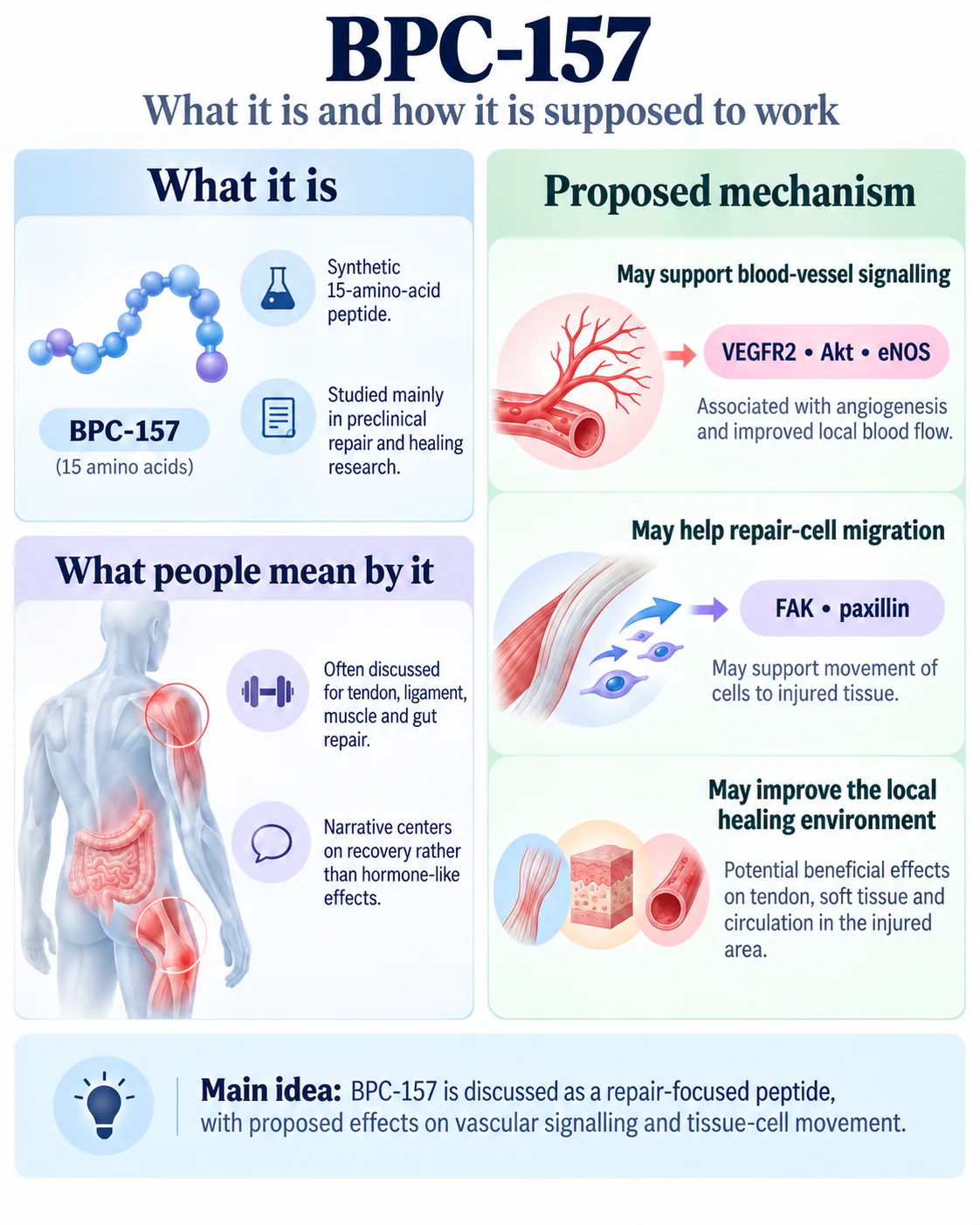 Open image at full size
Start with the claim, not the label
Before accepting a healing or recovery claim, find the actual study. Check what product was tested, in what setting and what was measured. Calling a substance a peptide, showing a chemical-purity certificate or sharing a testimonial does not establish that it works as a treatment. See storage claims, product quality and travel.
For tested sport, check peptides and anti-doping rules.24
Why the evidence gap matters
Laboratory and animal studies can justify further research. Researchers have studied models involving wounds, tendons, the gut, blood vessels and inflammation, and proposed effects on biological signals. These findings do not by themselves show that a product heals an injury in a person, that a usable amount is safe or that an online product matches what was studied. The species, timing, route, concentration and outcome may not have a direct human equivalent.
Read why laboratory promise can fail, AOD-9604 and cartilage claims, and what the ulcerative-colitis study reported.53
What human evidence exists?
A 2026 systematic review searched research through 1 June 2026. It identified three small human studies totalling 30 participants: a review of joint injections for knee pain involving 16 people, a bladder-treatment pilot involving 12, and an intravenous safety pilot involving two. The reviewers judged the studies at serious risk of bias and the overall certainty very low. These designs cannot provide a reliable comparative treatment effect or identify uncommon and delayed harms.
The intravenous pilot reported no side effects or measurable changes in its tested biological markers. But it followed only two people for three days. Both had previously received intravenous BPC-157 and paid for the product and testing; there was no control group. The authors’ broad conclusion that the results showed safety in humans goes beyond what this tiny, short study can establish. Results for one preparation or route cannot simply be transferred to another.
The review’s three studies are not every human investigation. For earlier randomised reports described by the FDA, and more recent registered studies, see the human-evidence guide.4510
What the two clinical case series actually report
The knee-pain report reviewed 17 clinic patients; 16 were reached by telephone. Twelve of those contacted had received BPC-157 alone, and four had also received another peptide. Authors reported improvement in 11 of the 12 who received BPC-157 alone. But patients recalled their symptoms, follow-up times and diagnoses varied, one person could not be reached, and there was no untreated or sham comparison. Patients paid for the treatment. The results cannot establish that BPC-157 caused improvement or repaired tissue.
Four patients had MRI scans before injection. The report did not present follow-up scans showing that cartilage, meniscus or ligament had healed. Recalled pain and scan-confirmed tissue repair are different outcomes. See the knee-pain study and the “11 out of 12” claim.
A second report looked back at 12 women treated for bladder pain at one clinic. It describes an examination and questionnaire at six weeks, with most patients contacted again four to six months after treatment. Authors reported improvement, but there was no sham control and participants paid for the experimental product. The authors declared no conflict of interest. Different conditions, routes and measurement methods mean the two reports cannot be treated as one controlled trial. Their designs do not establish the stronger treatment claims made in the reports.1112
What did an animal safety study find?
A 2020 report studied BPC-157 in several animal species. Its authors described it as well tolerated under their study conditions and reported no serious toxicity. In a separate 2026 assessment of the same line of research, the FDA highlighted changes in blood-clotting and liver-related laboratory measurements after repeated injections into muscle in rats and dogs. It described these as possible safety signals and said longer studies were unavailable to assess whether the signals persist or others emerge.
A laboratory signal does not prove people will develop a clotting or liver condition. Equally, a reassuring abstract does not establish safety in people, for another product or route, or for repeated long-term use. The original abstract and FDA presentation were reviewed here, not the full original paper.1314
The regulator’s specific concern
FDA notes possible immune reactions and difficulties related to peptide impurities and characterising the active ingredient. The agency also describes no or limited safety information for proposed routes. FDA briefing materials discuss spontaneous adverse-event reports, but such reports cannot establish causation or incidence because product identity, co-medications, dose, route and follow-up may be incomplete. This is a reason to report uncertainty clearly, not to convert an absence of data into an assurance.26
If you have used a BPC-157 product and develop a concerning symptom, seek medical advice promptly. For breathing difficulty, collapse or another life-threatening symptom, contact local emergency services immediately. Tell the clinician what you used, when you last used it and what other medicines or supplements you take; bring the packaging or a photo if available. In the US, patients and professionals can also report a suspected serious reaction or product-quality problem to FDA MedWatch. Reporting does not require proof that the product caused the problem and is not a substitute for medical care.1
In its July 2026 assessment, FDA said it found no studies administering BPC-157 to humans by the proposed oral, under-the-skin, nasal or transdermal routes. It also described small rectal-enema studies in which no serious adverse events were reported, but the reports gave limited safety-monitoring information. Findings from one route do not establish safety for another, and FDA said the available clinical information was insufficient to characterise the safety profile.14
Product and jurisdiction matter
A research-use label is not proof of safety or a substitute for an authorised medicine. Identity, sterility, concentration, stability, storage and contamination control matter, especially for injected or other nonstandard products. FDA compounding information describes a US regulatory and safety context. It is not a global legal guide or an approval record.7
The October 2026 U.S. policy does not mean approval
A Federal Register notice published on October 30, 2026 announced the availability of an HHS draft Enforcement Discretion Policy for certain peptide bulk substances used in Section 503A compounding. BPC-157 appears in the policy’s Appendix A. Under stated conditions, HHS says it does not intend to take enforcement action against specified state-licensed pharmacies, federal facilities or licensed physicians while the 503A bulk-drug list is developed through rulemaking. The policy is interim, does not establish rights, and is not binding on HHS or the public. Appendix B specifies BPC-157 acetate for subcutaneous, intramuscular, oral and topical forms under the policy’s conditions; that list does not establish that these routes are clinically effective or safe. For the full context and the separate 2027 discussion, see the US policy guide.89
Conditions do not establish effectiveness
The policy describes conditions including a patient-specific prescription, qualifying ingredient identity and characterization, certificates of analysis from an FDA-registered manufacturing source, single-active-ingredient products, reporting of serious adverse events and quality problems, specified labeling, and other Section 503A requirements. It also says compounded drugs are not FDA-approved and that FDA does not review their safety, effectiveness or quality before marketing. Meeting an enforcement-policy condition therefore does not show that BPC-157 heals an injury, treats ulcerative colitis, or has a validated human dose. It also does not determine access or legality outside the United States. For oral products, the policy also describes a requirement for documentation of adequate human bioavailability for the specific formulation. The policy’s conditions are not a substitute for clinical evidence.97
What would change this page?
Useful next evidence would include credible human studies of defined products, appropriate comparison groups, outcomes that matter to patients and adequate safety follow-up. Ask whether the product reached the relevant tissue, what was measured, how missing data were handled and whether harms were actively collected. This page explains the evidence gap; it is not a complete inventory of every experiment or a claim that no human observations exist.43
Where to go next
For the human studies, see the evidence in people. Seller-defined combinations vary: read what a stack can and cannot tell you, then check storage claims and border requirements before travel. Compare the specific route questions in BPC-157 capsules versus injections.
Development & regulatory context
These selected records are not a complete global legal-status list. Approval depends on the product, use, population and country; check each record’s date.
Compounded products containing BPC-157
FDA safety concerns; not an approval record
Proposed routes of administration
FDA lists BPC-157 among nominated-but-withdrawn substances on its safety-risk page. It says available safety information is insufficient to determine whether administration would cause harm. A compounding nomination or listing is not a product authorisation.2
Further reading
Trusted external resources selected to help explain this page. They open in a new tab.
- Glossary of common terms ↗Definitions for terms such as preclinical research, clinical trials and evidence.
- Preclinical safety evaluation of BPC-157 ↗2020 animal toxicology report; authors described no serious toxicity under tested conditions. Full paper not reviewed.
- FDA: compounding substances with potential safety risks ↗US regulator summary of potential risks and limitations for specified compounded substances; not a finding about every product.
- FDA advisory committee briefing: BPC-157 ↗2026 presentation assessing a proposed compounded substance and available evidence; not a product approval.
Sources, kept close.
Selected supporting sources; this is not a complete literature review.
- What is a Serious Adverse Event?U.S. Food and Drug Administration · Regulator safety-reporting explanation
- Bulk drug substances that may present significant safety risksUS Food and Drug Administration · Regulator safety information
- The Drug Development ProcessUS Food and Drug Administration · Regulator explanation
- Human evidence for BPC-157 in orthopaedic and regenerative medicine: a systematic review of efficacy and safetyPeer-reviewed systematic review / PubMed · Systematic review; very low certainty evidence
- BPC-157 as an Investigational Peptide Therapeutic: Biopharmaceutical Challenges, Formulation Strategies, and Translational Development BarriersPeer-reviewed review / PubMed · Translational and biopharmaceutical review
- July 23–24, 2026 Pharmacy Compounding Advisory Committee briefing materialsU.S. Food and Drug Administration · Regulator briefing; adverse-event reports and evidence limitations
- Compounding and the FDA: Questions and AnswersU.S. Food and Drug Administration · Regulator compounding information
- Enforcement Discretion Policy Regarding 503A Compounding Using Certain Peptide Bulk Drug SubstancesU.S. Department of Health and Human Services / Federal Register · Interim enforcement-discretion policy notice; not FDA approval or final rule
- HHS Enforcement Discretion Policy Regarding 503A Compounding Using Certain Peptide Bulk Drug SubstancesU.S. Department of Health and Human Services · Policy PDF; Appendix A/B conditions and scope
- Safety of Intravenous Infusion of BPC157 in Humans: A Pilot StudyLee and Burgess / Alternative Therapies in Health and Medicine · Published uncontrolled two-participant safety pilot; report inspected
- Intra-Articular Injection of BPC 157 for Multiple Types of Knee PainLee and Padgett / Alternative Therapies in Health and Medicine · Published retrospective uncontrolled case series; full report inspected
- Effect of BPC-157 on Symptoms in Patients with Interstitial Cystitis: A Pilot StudyLee et al. / Alternative Therapies in Health and Medicine · Published retrospective uncontrolled case series; full report inspected
- Preclinical safety evaluation of body protective compound-157, a potential drug for treating various woundsRegulatory Toxicology and Pharmacology / PubMed · Primary preclinical toxicology study, 2020
- July 2026 Pharmacy Compounding Advisory Committee: FDA BPC-157 presentationU.S. Food and Drug Administration · Regulator advisory committee presentation
- Sprains and strainsNHS · Public-health guidance