
The answer so far
Iron helps red blood cells carry oxygen around the body. Low iron stores can cause tiredness and may lead to anaemia. But tiredness has many possible causes, and you can have low iron without anaemia. It matters why iron is low: taking extra iron is not helpful for everyone and can cause harm.312
On this page
- What the nutrient does
- Why might iron stores fall?
- Does low iron always mean anaemia?
- Food, deficiency and safety
- Do food, tea and coffee change iron absorption?
- Do iron tablets always need vitamin C?
- What can ferritin and haemoglobin tell you?
- Can low iron cause fatigue without anaemia?
- Is iron better taken every day or on alternate days?
- What about side effects, dark stools and accidental exposure?
- What a supplement claim needs to show
- Sources
Before you read the detail
What it is
A mineral needed for haemoglobin and cellular functions; low stores can cause tiredness and progress to anaemia.35
What human evidence shows
Iron helps when deficiency is present; one trial found a small average fatigue advantage with uncertainty and no significant overall quality-of-life difference.45
What the nutrient does
Iron is part of haemoglobin, the protein in red blood cells that carries oxygen, and is involved in other cellular functions.3
The illustration includes liver, which is also rich in preformed vitamin A. UK pregnancy guidance advises avoiding liver and liver products; see vitamin A and pregnancy for the context.26
As a US dietary reference, the recommended intake for adults aged 19–50 is 8 mg of iron a day for men and 18 mg for women; for adults aged 51 and older it is 8 mg. The US reference during pregnancy is 27 mg, and during breastfeeding at ages 19–50 it is 9 mg. These amounts cover total intake, not a dose for treating anaemia. The US NIH notes that vegetarian diets may require more iron because plant-based iron is less readily absorbed. Needs and guidance differ by country and individual circumstances; excess supplemental iron can be harmful.3
For healthy adults, the US tolerable upper intake level for iron is 45 mg a day from all sources. It is not a target or an individual guarantee of safety. Clinicians may prescribe more for a time to treat iron-deficiency anaemia; do not stop or change prescribed iron because of this population limit. Accidental overdose can be dangerous, especially for children.3
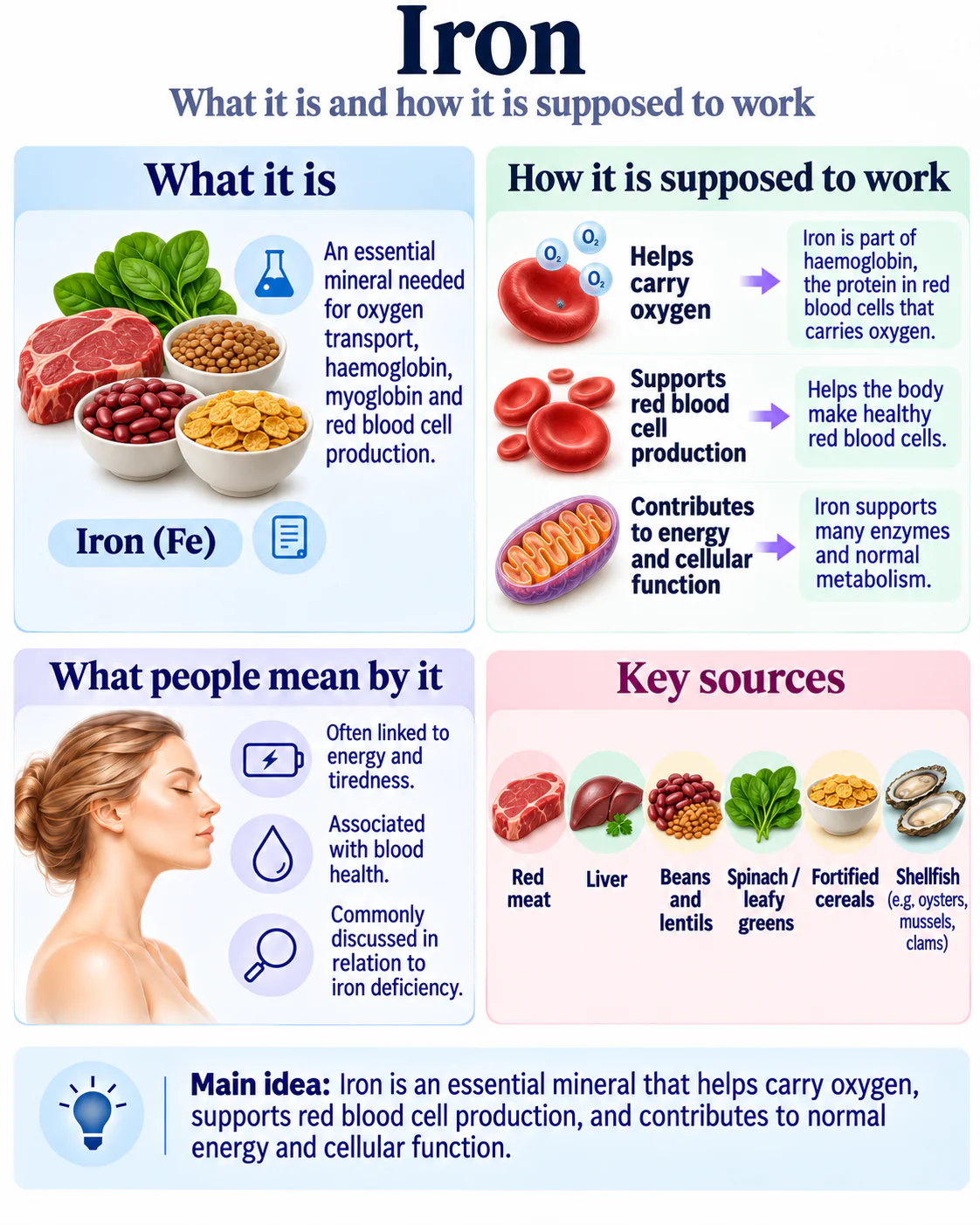
Read the image summary
Iron forms part of haemoglobin, which carries oxygen in the blood. Foods shown include meat, liver, legumes, greens, fortified cereals and shellfish; absorption varies. Iron deficiency needs assessment, and excess iron supplements can be dangerous, especially to children.
Why might iron stores fall?
Iron stores can fall if you do not get enough iron, if your gut cannot absorb enough, if your needs increase during growth or pregnancy, or if you lose blood. More than one cause can be involved. Heavy periods are one possible cause. Bleeding in the stomach or bowel is another and may not be obvious. Conditions such as coeliac disease can affect absorption. Medicines such as ibuprofen and aspirin can sometimes cause stomach or bowel bleeding; tell your clinician what you take, including non-prescription medicines. Discuss any prescribed medicine with its prescriber before changing it.312
In UK antenatal care, routine blood tests include checks at the first midwife appointment and around 28 weeks. If iron is low, the NHS says a GP or midwife may recommend an iron supplement. Testing and treatment vary by setting and individual circumstances; ask your maternity team how your results will be followed up.2612
What about after birth? WHO says oral iron, with or without folic acid, may be offered for 6–12 weeks after delivery to reduce anaemia risk in settings where anaemia in pregnancy is a public-health concern. This is population prevention guidance, not a treatment plan for an individual with confirmed anaemia. If you have low iron or anaemia after birth, ask your maternity team or clinician about the cause, treatment and follow-up in your circumstances.1
UK guidance recommends testing adults with confirmed iron-deficiency anaemia for coeliac disease as part of finding the cause. If testing is being considered, ask your clinician before changing your diet: avoiding gluten before testing can make the results inaccurate. If you already avoid gluten, tell the clinician rather than changing your diet on your own.14
A clinician will consider your history, symptoms and tests to investigate why iron is low. UK guidance says unexplained iron-deficiency anaemia in adults should prompt consideration of stomach and bowel causes. In men and postmenopausal women with newly diagnosed iron-deficiency anaemia, British gastroenterology guidance generally recommends gastroscopy and colonoscopy as first-line investigations, with alternatives such as CT colonography when colonoscopy is not suitable; the choice depends on the person and local care. This is different from iron deficiency without anaemia, where the same guidance describes a lower-risk situation but advises a low threshold for investigation in men, postmenopausal women and people with digestive symptoms or a family history of gastrointestinal disease. For other possible causes of tiredness, see energy and tiredness.13
A clinician may request a stool test called FIT, which looks for small amounts of blood. UK NICE guidance includes FIT when assessing adults with iron-deficiency anaemia for possible bowel cancer, though many causes are not cancer. A result below the referral threshold does not automatically end an investigation. NICE says clinicians should arrange follow-up and should not delay referral when there is strong concern about ongoing unexplained symptoms. Ask what your result means and when to get back in touch if symptoms continue or change.28
Does low iron always mean anaemia?
No. Iron deficiency means the body does not have enough available iron. Anaemia means haemoglobin—the oxygen-carrying protein in red blood cells—is below the relevant threshold. Iron can be low before anaemia develops, and anaemia can have causes other than low iron. Tiredness, breathlessness or paler skin can occur with iron-deficiency anaemia, but those symptoms alone do not identify the cause.125
The section on ferritin and haemoglobin below explains what the tests can and cannot show. A clinician can consider the whole picture rather than relying on one result.
A lack of vitamin B12 or folate can also cause anaemia, and B12 deficiency can affect nerves even without anaemia. A blood count or tiredness alone cannot tell you which cause applies. See vitamin B12 and deficiency.27
Breathlessness has other possible causes. Seek emergency help immediately for severe difficulty breathing, such as gasping or being unable to get words out, or if your chest feels tight or heavy. Do not assume these symptoms are caused by low iron.29
Food, deficiency and safety
Iron occurs in meat and seafood, as well as beans, lentils, leafy greens and fortified cereals. Absorption varies by iron form and the other foods eaten. Iron deficiency and anaemia need assessment because there can be different causes. Iron supplements can cause digestive effects and excess iron can be harmful; accidental overdose is especially dangerous for children. Store supplements out of children’s reach.3
Read how iron, calcium and biotin can affect thyroid medicine or tests.
Iron products can also interact with some medicines. The UK NHS lists antibiotics including doxycycline and ciprofloxacin among medicines to discuss when taking ferrous sulfate. Ask a pharmacist or prescriber about the exact products and timing; do not stop an antibiotic or change a prescribed treatment on your own. See supplement and medicine interactions.2
Taking iron and zinc supplements? Read how iron supplements can affect zinc absorption.
Do food, tea and coffee change iron absorption?
Foods contain different forms of iron. Foods with vitamin C can help the body absorb non-haem iron, the form found in plant foods such as beans and lentils. Tea or coffee with a meal can reduce absorption. These effects do not prove that a particular meal will cause or cure deficiency. A person with diagnosed iron deficiency also needs assessment of the cause and an appropriate treatment plan.8
Iron medicines and supplements are a separate question. For ferrous sulfate, NHS guidance says tea, coffee, dairy and eggs can reduce absorption and advises waiting two hours after taking it before having those foods or drinks. Food may help if the medicine upsets your stomach. Instructions differ by product, and other medicines can matter. Ask a pharmacist or prescriber rather than applying one timing rule to every product. Too much iron can be harmful, especially to children.18
Do iron tablets always need vitamin C?
No. Vitamin C can help the body absorb iron, but that does not prove an extra vitamin C supplement improves treatment for everyone.
In a 2020 trial at one Chinese hospital, 440 adults with iron-deficiency anaemia were randomly assigned iron tablets with or without vitamin C; 426 were women. Participants and clinicians knew which treatment was given. After two weeks, haemoglobin rose by an average of 2.00 g/dL with vitamin C and 1.84 g/dL with iron alone. The difference met the study’s equivalence criterion for this outcome, using a margin chosen in advance of plus or minus 1 g/dL. That does not mean the results were identical.7
The trial studied a particular treatment and group, not every iron product, diet, pregnancy or cause of anaemia. It does not show that vitamin C has no role in absorbing iron from food, or that you should change prescribed treatment. Discuss your product with a clinician. See also vitamin C.
What can ferritin and haemoglobin tell you?
Ferritin is a protein that stores iron. Its level in blood helps clinicians assess iron stores. Haemoglobin is the protein in red blood cells that carries oxygen.5
Iron stores can fall before haemoglobin drops below the level used to define anaemia. A normal haemoglobin result alone therefore does not rule out low iron stores. Infection or inflammation can raise ferritin, so a result in the normal range does not always rule out deficiency either. High ferritin can have several causes and does not by itself establish iron overload.5
A clinician can interpret results alongside your symptoms, history and, when needed, other tests. One example is transferrin saturation, which estimates how much of the iron-transport protein is carrying iron. Ranges and thresholds do not apply identically to everyone; do not use a single online cutoff to diagnose or treat yourself.56
After treatment starts for confirmed iron-deficiency anaemia, blood tests help the care team check the response. For adults taking oral iron, the British Society of Gastroenterology recommends checking haemoglobin within the first four weeks and continuing treatment for around three months after it returns to normal, to rebuild iron stores. The right duration and monitoring depend on the cause and circumstances. Agree a plan with your prescriber instead of stopping or continuing iron on your own.6
For adults with iron-deficiency anaemia, the BSG advises that iron replacement generally should not be delayed while the cause is investigated, unless a colonoscopy is imminent. Once haemoglobin and iron stores have recovered, it recommends periodic blood counts to look for recurrence, suggesting that checks might initially be about six months apart. The guideline rates the evidence for this monitoring recommendation as very low certainty. The follow-up interval is an example, not a schedule for everyone; agree the plan with your care team.6
If oral iron causes persistent problems or haemoglobin does not improve as expected, contact the prescriber. In adults with iron-deficiency anaemia, the BSG says clinicians may consider a less frequent schedule, another oral preparation or intravenous iron when oral treatment is not tolerated, ineffective or unsuitable, or when correction is particularly urgent. A poor response may also prompt a review of absorption, ongoing blood loss or the diagnosis. Intravenous iron has its own risks, including infusion reactions; the choice is individual, not a reason to change treatment without advice.6
- FerritinA marker that helps assess stored iron. Infection or inflammation can raise it.
- HaemoglobinThe oxygen-carrying protein in red blood cells. A low level can indicate anaemia, which has several causes.
- TogetherIron stores may be low even when haemoglobin is normal. A clinician interprets results in context.
Can low iron cause fatigue without anaemia?
Yes. Iron stores can be low before someone meets the criteria for anaemia, although tiredness has many possible causes.3
In a 2012 trial, 198 menstruating women with unexplained fatigue, low or borderline ferritin and no anaemia were assigned iron or a placebo for 12 weeks. Both groups improved on a 40-point fatigue questionnaire. The iron group improved by about 3.5 points more on average, but the 95% confidence interval ranged from about 0.3 to 6.7 points more, leaving considerable uncertainty about the size. An analysis that excluded people who did not follow the study plan was less conclusive. There was no statistically significant overall difference in quality of life.4
The findings do not show that everyone who is tired needs iron or identify the cause of one person’s symptoms. The iron-product manufacturer Pierre Fabre Médicament sponsored and designed the study and managed its data; the authors reported independent analysis. A clinician can assess why iron is low and whether treatment is appropriate.4
Is iron better taken every day or on alternate days?
There is no single schedule that is best for everyone. Iron can cause nausea, constipation or other digestive symptoms, and clinicians may consider how well a person tolerates treatment alongside how quickly their iron levels need to improve. Hepcidin, a hormone that helps regulate iron, can rise after an iron dose and temporarily reduce absorption of a later dose. A change in absorption does not by itself establish the best clinical schedule.1011
In a 2023 double-blind Swiss trial, 150 young women with low iron stores were assigned either iron daily for 90 days or iron on alternate days for 180 days; the total planned amount was the same. The daily group then received placebo for another 90 days. At the end of each iron course, ferritin, a marker of iron stores, was similar; the absence of a clear difference does not prove the schedules are equivalent. Digestive symptoms on days iron was taken were reported more often in the daily group. The groups reached the same planned total at different times, so the comparison does not prove that both schedules replenish iron equally quickly. Participants were not pregnant or breastfeeding, and people with moderate-to-severe anaemia or major chronic illness were excluded.10
The right choice depends on the cause and severity of deficiency, the product, side effects and other circumstances. Do not change a prescribed schedule solely on the basis of this study; discuss difficulties with a clinician or pharmacist. For a different interaction, see iron and thyroid medicine.1011
What about side effects, dark stools and accidental exposure?
Iron products can cause nausea, constipation, diarrhoea or stomach pain. A pharmacist or prescriber can help with troublesome effects and check the exact formulation; do not change a prescribed treatment based on a general schedule. Ferrous sulfate drops can stain teeth; the NHS advises rinsing the mouth with water after the drops. It also advises swallowing the tablets whole rather than sucking, chewing or holding them in the mouth.15
Stools often become darker with iron. But the UK NHS advises prompt medical advice if stools are black, tar-like or red, contain blood, or if you feel unwell. Heavy or continuous rectal bleeding needs emergency care. Do not assume a worrying change is simply the iron.1516
Rarely, ferrous sulfate can cause a serious allergic reaction. Sudden swelling of the lips, mouth, tongue or throat, difficulty breathing or swallowing, or collapse needs emergency help immediately.15
Keep iron products out of children’s reach. If a child or adult may have swallowed too much, seek urgent advice from your local poison service or emergency service immediately, even if they seem well; take the packaging if available. Services differ by country.1720
United Kingdom: NHS guidance says call 999 or attend emergency care if a harmful substance may have been swallowed; call 111 if unsure whether it was harmful. United States: Poison Help is 1-800-222-1222; call 911 for collapse, seizure, breathing difficulty or inability to wake.19202125
Spain: the Toxicological Information Service is 91 562 04 20. Italy: Milan Poison Centre is 02 6610 1029; other local poison centres also provide advice. For a life-threatening emergency in the EU, call 112. Elsewhere, use the local emergency or poison service. Follow the responding professionals’ directions; the NHS advises against making someone vomit or giving food or drink while waiting.22232417
What a supplement claim needs to show
Tiredness has many possible causes. Taking iron without knowing whether it is needed is not a reliable way to address fatigue. Read the supplement label guide and the interaction guide for practical context.
For other possible explanations of tiredness, explore energy and tiredness.3
Further reading
Trusted external resources selected to help explain this page. They open in a new tab.
- Iron: Health Professional Fact Sheet ↗US scientific overview of dietary iron, deficiency and safety.
- Effect of iron supplementation on fatigue in nonanemic menstruating women with low ferritin: a randomized controlled trial ↗Manufacturer-sponsored trial in a selected population; self-reported fatigue, not an individual treatment recommendation.
- WHO guideline on use of ferritin concentrations to assess iron status in individuals and populations ↗Guideline on interpreting iron status; clinical context matters.
- British Society of Gastroenterology guidelines for the management of iron deficiency anaemia in adults ↗Guideline on interpreting iron status; clinical context matters.
Sources, kept close.
Selected supporting sources; this is not a complete literature review.
- Iron supplementation with or without folic acid to reduce the risk of postpartum anaemiaWorld Health Organization · WHO public-health recommendation
- Taking ferrous sulfate with other medicines and herbal supplementsNHS · UK patient medicine guidance
- Iron: Health Professional Fact SheetNIH Office of Dietary Supplements · Official nutrition evidence summary
- Effect of iron supplementation on fatigue in nonanemic menstruating women with low ferritin: a randomized controlled trialCMAJ · Randomized placebo-controlled trial
- WHO guideline on use of ferritin concentrations to assess iron status in individuals and populationsWorld Health Organization · 2020 international guideline on ferritin and iron status; individual and population use
- British Society of Gastroenterology guidelines for the management of iron deficiency anaemia in adultsBritish Society of Gastroenterology / Gut · 2021 UK adult clinical guideline on iron deficiency anaemia
- The Efficacy and Safety of Vitamin C for Iron Supplementation in Adult Patients With Iron Deficiency AnemiaJAMA Network Open · Randomized clinical trial, 2020
- Iron and coeliac diseaseCambridge University Hospitals NHS Foundation Trust · UK patient dietary guidance
- About ferrous sulfateNHS · UK medicine information
- Alternate day versus consecutive day oral iron supplementation in iron-depleted women: a randomized double-blind placebo-controlled studyeClinicalMedicine / PubMed Central · Randomized controlled trial
- Iron absorption from oral iron supplements given on consecutive versus alternate days and as single morning doses versus twice-daily split dosing in iron-depleted womenThe Lancet Haematology / PubMed · Randomized physiological absorption studies
- Iron deficiency anaemiaNHS · UK patient guidance
- Guidelines for the management of iron deficiency anaemia in adultsBritish Society of Gastroenterology · Clinical guideline summary; original guideline 2021, reviewed 2026
- Coeliac disease: diagnosisNational Health Service · UK patient guidance
- Side effects of ferrous sulfateNHS · Named-medicine patient guidance
- Bleeding from the bottom (rectal bleeding)NHS · Symptom-based patient guidance
- PoisoningNHS · Patient emergency guidance
- How and when to take ferrous sulfateNHS · UK patient guidance for a named iron medicine
- PoisoningNHS · UK general poisoning and urgent care advice
- First Steps in a Poisoning EmergencyUS Health Resources and Services Administration · US federal poison-service first steps
- When accidents happen with chemicals or medicine, call Poison HelpUS Health Resources and Services Administration · US federal poison-service emergency guide
- Servicio de Información Toxicológica: publicacionesInstituto Nacional de Toxicología y Ciencias Forenses · Spain government poison information service and public number
- Contatti: Centro Antiveleni di MilanoCentro Antiveleni di Milano · Italian poison centre emergency contact; available 24 hours
- 112: the EU emergency phone numberEuropean Commission · EU emergency services access
- First aid: Act fastNational Capital Poison Center · US poison-centre first aid and emergency response
- Pregnancy vitamins and supplementsNHS · Official pregnancy guidance; United Kingdom
- Vitamin B12 deficiency in over 16s: diagnosis and managementUK National Institute for Health and Care Excellence · UK clinical guideline NG239, 2024, updated December 2024
- Suspected cancer: recognition and referral — colorectal cancer recommendationsNational Institute for Health and Care Excellence · UK clinical guideline
- Shortness of breathNHS · UK patient guidance