
The answer so far
Vitamin B12 helps keep nerves and blood cells healthy and helps the body make DNA. A person can develop a deficiency because they do not get enough B12 or cannot absorb enough, even when their diet contains it. Treating a deficiency is different from taking extra B12 for energy when levels are already adequate.1
On this page
Before you read the detail
What it is
A vitamin needed for blood-cell formation and nervous-system function; deficiency treatment depends on cause.1
What human evidence shows
Oral and injected treatment have been studied, but the approach depends on absorption, medicines, symptoms and cause.65
Main cautions
Metformin and nitrous oxide can be relevant to deficiency risk; neurological symptoms need assessment.47
Current status
Testing and replacement should follow clinical assessment and local guidance.5
What B12 does and where it comes from
B12 is a water-soluble vitamin needed for the nervous system, blood cells and DNA. Meat, fish, eggs and dairy naturally contain it; some cereals and nutritional yeasts have B12 added. People who do not eat animal products need a reliable source, such as appropriately fortified foods or supplements.1
Not every plant-based milk, cereal or nutritional yeast has B12 added, and amounts vary. Check the label and serving size. A plant-based diet does not by itself mean someone is deficient, but it needs a reliable B12 source. Absorption problems can cause deficiency whatever someone eats.1
For healthy adults aged 19 and older, the US recommended dietary allowance is 2.4 micrograms of B12 per day; the US reference is 2.6 micrograms during pregnancy and 2.8 micrograms while breastfeeding. These are reference amounts for total intake from food, fortified products and supplements, not doses for treating a deficiency. Requirements and guidance may differ by country and individual circumstances.1
During pregnancy and breastfeeding, discuss B12 intake and absorption with a clinician or dietitian. B12 passes to a baby during pregnancy and through breast milk; a breastfeeding parent’s deficiency can affect the baby. Diet and absorption conditions both matter. Ask for advice suited to the parent, baby and products used. See also folate and folic acid.111
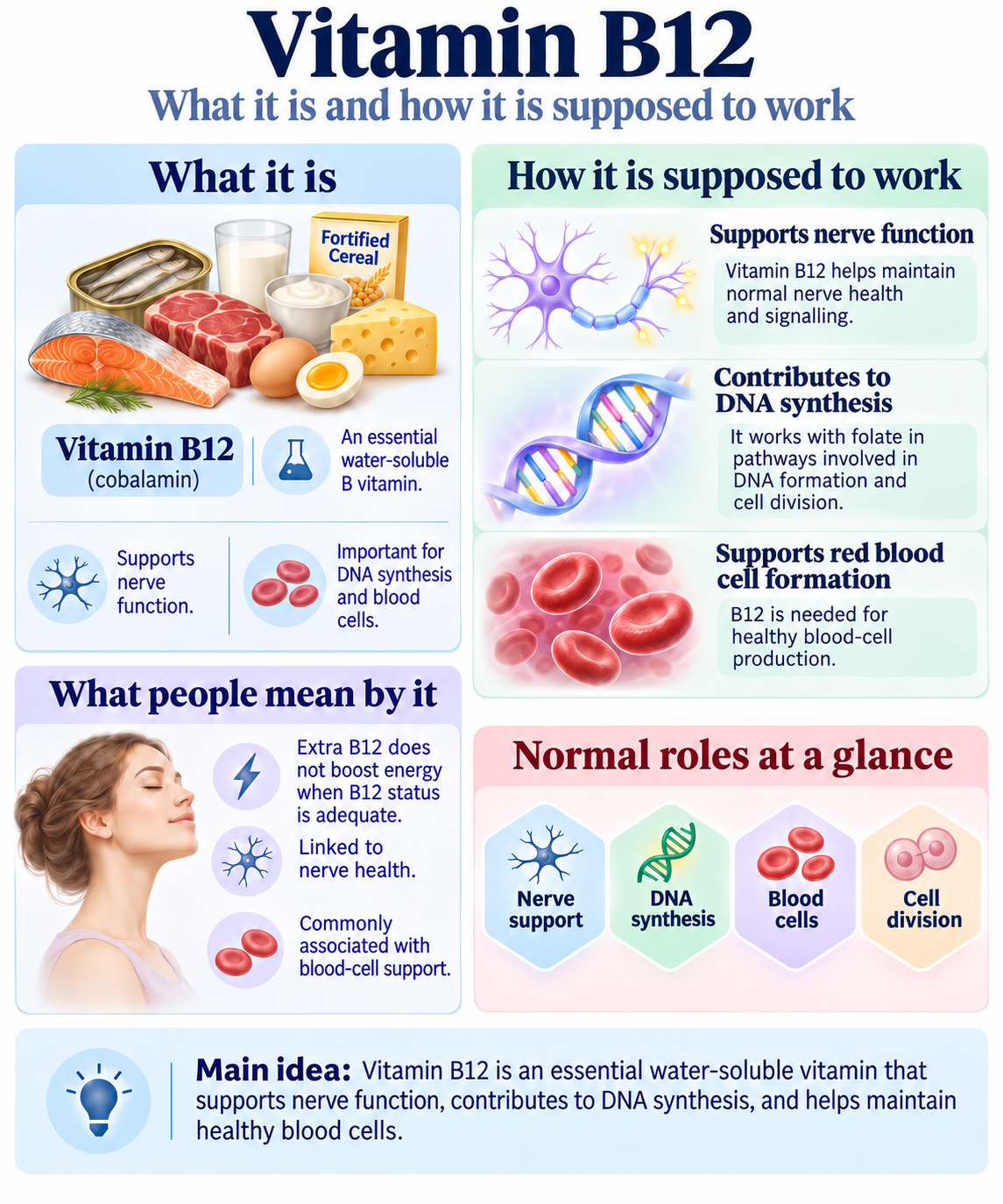
The illustration describes normal roles of vitamin B12 and mentions energy. That does not mean extra B12 boosts energy when a person already has adequate B12 status; fatigue can have many causes.1
Read the image summary
Vitamin B12 is a water-soluble vitamin needed for nerve function, DNA synthesis and red blood cell formation. Sources include animal foods and some fortified cereals. People who eat no animal products need a reliable source of B12; problems with absorption can cause deficiency even when intake appears adequate. The image mentions energy, but extra B12 does not boost energy in people who already have adequate B12 status.
Absorption is part of the picture
Some gastrointestinal conditions, surgery, lack of intrinsic factor, and prolonged use of certain medicines can affect B12 absorption. Deficiency can cause anaemia and neurological changes, and assessment and treatment depend on the cause. The presence or absence of a single symptom is not enough to diagnose it.15
Acid-reducing medicines, including proton-pump inhibitors and H2-receptor blockers, can affect B12 absorption from food. Their use is a risk factor, not proof of deficiency; discuss concerns with the prescriber rather than stopping a prescribed medicine.1
One possible cause is autoimmune gastritis, in which the immune system affects cells in the stomach. This can reduce intrinsic factor, a protein needed for normal B12 absorption. The term pernicious anaemia is sometimes used in this context; B12 deficiency from this condition can occur without anaemia. If a clinician suspects autoimmune gastritis, an anti-intrinsic-factor antibody test may help, but a negative result does not rule it out. Other investigations may be needed. This is a question about the cause of a deficiency, distinct from measuring B12 itself.5
Autoimmune gastritis also affects follow-up beyond B12 replacement. NICE notes a higher risk of gastric neuroendocrine tumours and a possible higher risk of stomach adenocarcinoma, another type of stomach cancer in people with this condition; this does not mean that everyone will develop cancer. If autoimmune gastritis is suspected or confirmed, tell a clinician about new or worsening upper digestive symptoms, such as indigestion, nausea or vomiting. These symptoms have many causes. NICE advises clinicians to consider referral for an endoscopy in this situation.5
Coeliac disease is another possible cause of poor absorption. When the cause of B12 deficiency remains unknown after further investigations, NICE recommends testing for coeliac disease in its guidance for people aged 16 and over. Avoiding gluten before coeliac testing can make results inaccurate. If testing is being considered, discuss your current diet and the testing plan with your clinician before changing it; if you already avoid gluten, ask for individual advice rather than reintroducing it on your own.513
Can B12 deficiency occur without anaemia?
Yes. B12 deficiency can affect nerves even when a blood count does not show anaemia. Numbness, pins and needles or balance problems can have many causes; they do not by themselves establish a B12 deficiency. UK NICE guidance says not to rule it out solely because anaemia or enlarged red blood cells are absent. A clinician can assess symptoms and risk factors and decide on tests. Tell them about any B12 products already used, because supplements can affect test interpretation. New or worsening nerve symptoms deserve prompt medical assessment.51
If an initial B12 result is inconclusive and symptoms suggest deficiency, NICE says a clinician may consider a blood test for methylmalonic acid (MMA). MMA can also be raised for other reasons, including reduced kidney function, so it does not diagnose deficiency by itself.5
NICE advises taking diagnostic blood samples before replacement when possible. It also says not to delay treatment while awaiting results in people with suspected megaloblastic anaemia and neurological symptoms. These are clinical decisions, not instructions to delay care or start treatment without advice. See B6, B12 and nerve symptoms and what B12, MMA and homocysteine tests mean.5
Iron deficiency is another possible cause of anaemia and can also occur without it. Tiredness or a normal blood count alone cannot identify the cause. See iron, ferritin and anaemia.10
Can nitrous oxide cause B12-related nerve damage?
Yes. Nitrous oxide, sometimes called laughing gas, can inactivate B12. Repeated or heavy exposure can damage nerves or the spinal cord, causing tingling, numbness, weakness or difficulty walking and balancing. Some harm can persist. Nitrous oxide is also used under medical supervision for anaesthesia and pain relief. The UK medicines regulator notes that someone with an existing B12 deficiency can be vulnerable even after a single medical exposure. Tell the anaesthesia team about a known deficiency or relevant symptoms.78
A normal blood count or total B12 result does not rule out this problem: a test can measure B12 that is present but no longer works normally. A clinician may consider other tests, such as MMA or homocysteine, alongside symptoms and exposure. A 2024 report described 251 people seen by neurologists after excessive recreational use. Because these were patients who sought specialist care, the report cannot tell us the chance of harm among everyone exposed.79
Taking B12 does not make continued nitrous oxide use reliably safe. The UK Advisory Council on the Misuse of Drugs reports nerve problems despite supplementation in a small case series and describes stopping exposure as part of treatment. Anyone with suspected nerve symptoms should seek prompt medical assessment and tell the clinician about nitrous oxide use. New or worsening weakness or difficulty walking warrants urgent care. See nitrous oxide and B12-related nerve problems.8
Are tablets as effective as injections?
Both tablets and injections are used to treat B12 deficiency. The choice depends on the cause and the person’s circumstances. A 2018 Cochrane review found three randomised trials involving 153 people, followed for three to four months. Its low-certainty evidence suggested similar effects on returning B12 blood levels to normal.6
The trials were short and did not report clinical symptoms or quality of life. A blood result alone cannot establish that each route works equally well for every person or over the long term. NICE recommends injections for some causes of poor absorption and considers oral treatment in other situations. For deficiency caused or suspected to be caused by malabsorption, NICE specifies at least 1 mg a day when oral replacement is prescribed. This is treatment guidance, not a general daily target or a reason to switch from injections. A clinician can choose the product, route and follow-up. Do not switch or stop prescribed treatment based on a general comparison. For differing instructions, see whether to take vitamins with food.65
What happens after treatment starts? NICE says symptoms may begin to improve within two weeks but can take up to three months to start improving; complete recovery may take longer. Some nerve problems can persist. Follow-up considers symptoms as well as the treatment plan. Seek advice without waiting for a scheduled visit if symptoms worsen, return or new symptoms appear.5
Some causes need long-term replacement. NICE recommends lifelong injections when autoimmune gastritis is confirmed or suspected. That does not mean everyone with low B12 needs lifelong injections.5
Metformin and B12: what was measured?
Metformin, used for type 2 diabetes and other conditions, can reduce B12 absorption. In a 2010 trial, 390 adults with type 2 diabetes who also used insulin received metformin or a placebo for about 4.3 years. At the end, the proportion whose blood B12 was below the study’s deficiency threshold was 7.2 percentage points higher in the metformin group.3
A difference in blood levels does not mean everyone developed symptoms or predict an individual’s risk. The UK medicines regulator advises assessment for people taking metformin who develop possible symptoms, such as new or worsening pins and needles or marked tiredness. It also advises considering monitoring for people with risk factors. These symptoms can have other causes. Do not stop prescribed metformin on your own; discuss concerns and testing with the prescriber.4
Supplements and energy claims
B12 is available in different supplement forms and as prescription treatment. Correcting a deficiency is distinct from the claim that B12 boosts energy when a person already has adequate status. The right response to a suspected deficiency depends on individual circumstances and clinical assessment. Folic acid can correct anaemia without correcting the neurological effects of B12 deficiency; see the folate profile. For a separate trial of a multivitamin and memory tests, see multivitamins and memory.12
When treating folate-deficiency anaemia, the UK NHS explains that clinicians check B12 because folic acid can improve anaemia while an underlying B12 deficiency remains untreated. This is not a reason to stop folic acid prescribed or recommended for pregnancy: discuss the individual plan and any concern about B12 with a clinician.12
If you are considering an over-the-counter oral B12 supplement, UK NICE says some products do not contain enough B12, or a suitable type, to treat deficiency. It lists cyanocobalamin, methylcobalamin and adenosylcobalamin as types to look for on the label. The name alone does not establish the right amount or treatment for you: ask a clinician or pharmacist to check the product and your circumstances. Tell your clinician about any B12 already taken because it can affect blood-test results.5
Further reading
Trusted external resources selected to help explain this page. They open in a new tab.
- Vitamin B12: Health Professional Fact Sheet ↗US scientific overview of B12, absorption and deficiency.
- Long term treatment with metformin in patients with type 2 diabetes and risk of vitamin B-12 deficiency: randomised placebo controlled trial ↗Trial in insulin-treated adults with type 2 diabetes; biochemical outcomes do not establish every person’s symptoms.
- Metformin and reduced vitamin B12 levels: new advice for monitoring patients at risk ↗UK drug safety advice about metformin and reduced B12; decisions about testing depend on the individual.
- Vitamin B12 deficiency in over 16s: diagnosis and management ↗UK guidance for people over 16; diagnostic and treatment decisions are individual.
- Oral vitamin B12 compared with intramuscular vitamin B12 for vitamin B12 deficiency ↗Three small trials; blood levels were measured, not clinical symptoms or quality of life.
Sources, kept close.
Selected supporting sources; this is not a complete literature review.
- Vitamin B12: Health Professional Fact SheetNIH Office of Dietary Supplements · Official nutrition evidence summary
- Folate: Health Professional Fact SheetNIH Office of Dietary Supplements · Official nutrition evidence summary
- Long term treatment with metformin in patients with type 2 diabetes and risk of vitamin B-12 deficiency: randomised placebo controlled trialThe BMJ · Randomized placebo-controlled trial
- Metformin and reduced vitamin B12 levels: new advice for monitoring patients at riskUK Medicines and Healthcare products Regulatory Agency · Regulator drug safety update
- Vitamin B12 deficiency in over 16s: diagnosis and managementUK National Institute for Health and Care Excellence · UK clinical guideline NG239, 2024, updated December 2024
- Oral vitamin B12 compared with intramuscular vitamin B12 for vitamin B12 deficiencyCochrane · 2018 systematic review of three randomised trials
- Nitrous oxide: neurological and haematological toxic effectsUK Medicines and Healthcare products Regulatory Agency · Regulator safety update
- Nitrous oxide: updated harms assessmentUK Advisory Council on the Misuse of Drugs · Government advisory harms assessment
- Neurological complications of excessive recreational nitrous oxide use: a case series based on a text mining algorithmPubMed · Retrospective specialist case series; abstract
- Guidelines for the management of iron deficiency anaemia in adultsBritish Society of Gastroenterology · Clinical guideline summary; original guideline 2021, reviewed 2026
- Vitamin B12 and BreastfeedingUS Centers for Disease Control and Prevention · Public-health guidance for health professionals
- Vitamin B12 or folate deficiency anaemia: treatmentNHS · UK patient guidance
- Coeliac disease: diagnosisNational Health Service · UK patient guidance