
The answer so far
Retatrutide is an investigational peptide being studied for several conditions. It acts on three hormone-receptor systems: GIP, GLP-1 and glucagon. That explains the research idea, but only trials can measure benefits and harms. A company pipeline update is not an independent approval decision. Digestive side effects and changes in heart rate were reported in early studies; uncommon and long-term risks remain uncertain.2
On this page
- Why several signals?
- The evidence example in this edition
- What the 2023 analysis estimates
- What changed after phase 2?
- What the 2026 phase 3 reports add
- What safety means here
- Mechanism, exposure and outcome are different links
- Why the phase 2 result is not a ranking
- What the 2023 trial did and did not include
- Common events are not the whole safety assessment
- How to read later status claims
- Source access and review status
- The questions that remain useful
- Can retatrutide improve sleep apnoea?
- Questions that still need answers
- Sources
Before you read the detail
What it is
An investigational peptide designed to act on three metabolic signalling receptors.2
What human evidence shows
Human trials have studied weight and other outcomes; a historical Phase 2 trial is explained separately.34
Main cautions
Gastrointestinal adverse effects and other safety questions require the full trial context and longer follow-up.3
Current status
Development and regulatory status must be checked against current records for the specific country and use.2
Why several signals?
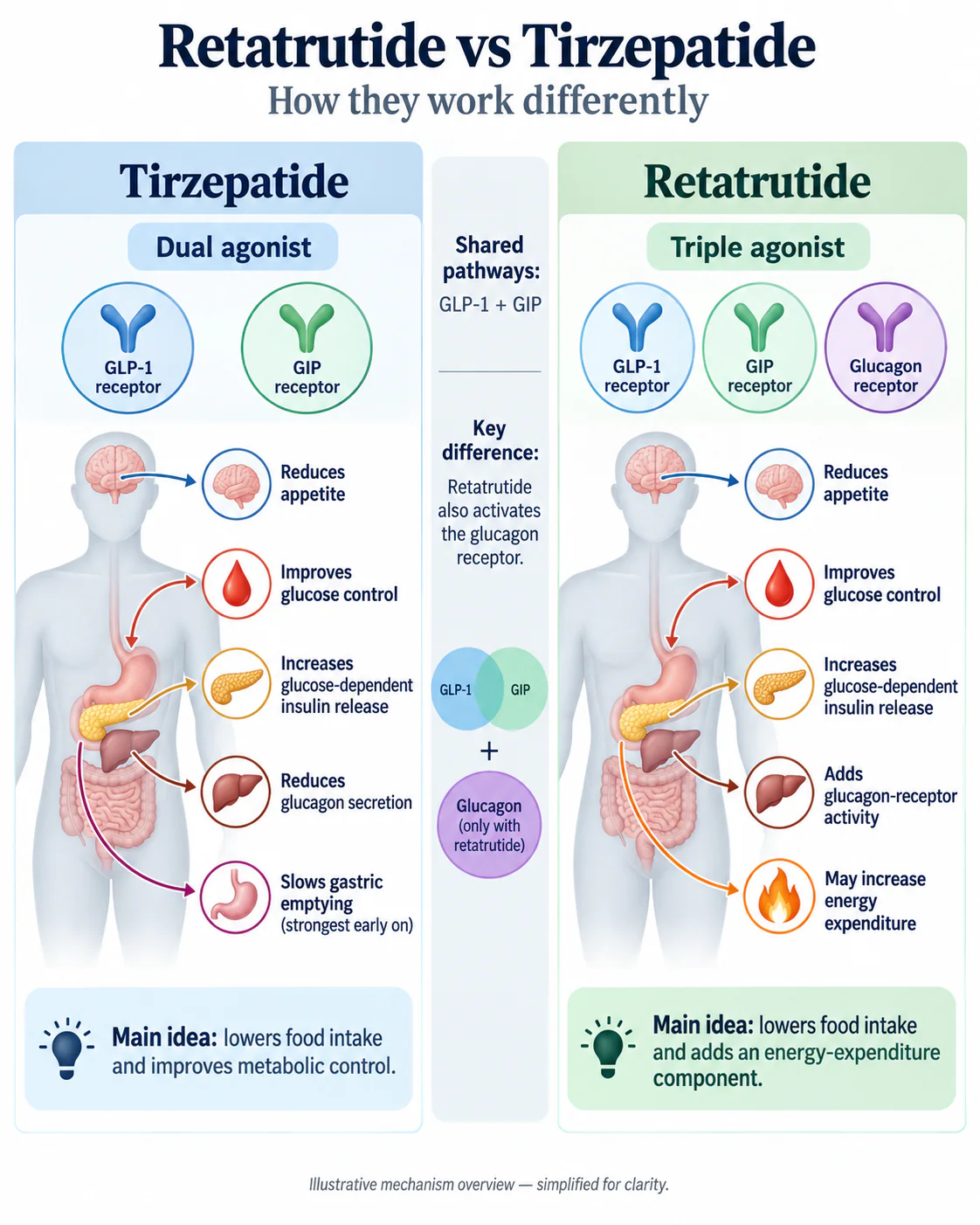
Retatrutide is one molecule designed to act on GIP, GLP-1 and glucagon receptors. This does not prove that each target provides a separate benefit or that the effects simply add together. Read why one medicine can affect several signals, product quality and storage claims, and what “fat burning” and appetite claims mean.2
Illustrations
The diagram simplifies proposed mechanisms. Retatrutide is investigational; the image does not establish its effects or approval.
 Open image at full size
The evidence example in this edition
The 2023 phase 2 explainer is a historical example. It describes who was studied, the comparison and the difference between the main outcome and a later outcome. It is not a complete review of later evidence or a statement of the current development stage.342
What the 2023 analysis estimates
The main effectiveness analysis estimated the average difference between retatrutide and placebo if treatment were taken as intended. The effectiveness and safety analyses included people under different rules, so their group sizes should not be assumed to match. The report also describes another, hybrid analysis. The authors caution that no adjustment was made for multiple tests or confidence intervals, so those intervals should not be treated as definitive evidence of an effect.341415
What changed after phase 2?
Later trials studied different people and outcomes. Each needs to be assessed separately, alongside harms and the product’s regulatory status. Later findings do not make every earlier result applicable to every person.2
What the 2026 phase 3 reports add
Three 2026 peer-reviewed reports studied different groups and questions. All were funded by Lilly.567
TRIUMPH-1 assigned 2,339 adults with obesity but without diabetes to treatment or placebo for 80 weeks. Average weight change was −17.6%, −23.7% and −25.0% with 4, 9 and 12 mg, compared with −3.9% with placebo. The weight analysis addressed outcomes regardless of treatment stopping. The main pain and sleep-apnoea outcomes were tested in groups of 574 and 243 participants using a different, hybrid analysis; the publisher also reported intention-to-treat results. Digestive events were most common.510
TRIUMPH-2 assigned 1,152 adults with obesity and type 2 diabetes for 80 weeks. Average weight change was −11.9%, −16.8% and −18.8%, compared with −5.1% for placebo. Diarrhoea, nausea, low blood pressure and altered sensation were more frequent with retatrutide. Permanent stopping because of adverse events or death was 4%, 12%, 8% and 5% in the 4-, 9-, 12-mg and placebo groups respectively.6
TRANSCEND-T2D-1 studied 537 adults whose type 2 diabetes was inadequately controlled by diet and exercise alone, for 40 weeks. HbA1c, a measure of average blood glucose over several months, changed by −1.69, −1.86 and −1.94 percentage points, compared with −0.81 for placebo. Weight changed by −11.5%, −13.9% and −15.3%, compared with −2.6%. Adverse events were generally mild-to-moderate digestive events. Stopping because of adverse events was 2–5% with retatrutide and 0% with placebo; two deaths in the 4-mg group were judged unrelated.7
These findings were checked against publisher-indexed text and trial abstracts. They are not approval decisions or direct comparisons between medicines. Do not combine the trials into a single ranking.
What safety means here
Safety findings depend on the product, people, exposure and follow-up studied. The historical phase 2 report recorded digestive adverse events and heart-rate increases that varied with dose. A product sold outside the research programme is not equivalent to the trial medicine simply because it uses the same substance name.
As checked on 6 November 2026, the US FDA says retatrutide is not a component of an FDA-approved drug, has not been found safe and effective for any condition, and cannot be used in compounding under US federal law. It warns that some unapproved products sold directly to consumers carry “for research purposes” or “not for human consumption” labels; their quality is unknown and they may be harmful. Such a label does not make them equivalent to the trial medicine. If you have used a product and are concerned, tell a health professional what you took and bring the packaging. Rules and availability differ by country.3218
In a separate 5 November 2026 Australian safety advisory, TGA testing found that Synedica Retatrutide 10 mg products contained less retatrutide than their labels stated, with substantial variation between tested samples. This finding concerns those tested products and does not describe the trial medicine. The TGA advises people with Synedica-branded peptide products to stop using them, take remaining product to a local pharmacy for safe disposal in Australia, and speak to a health professional if concerned about their health.19
Mechanism, exposure and outcome are different links
A molecule can activate a receptor in a laboratory test or change a biological marker in a person without improving an outcome that matters to patients. Exposure over time, receptor location, other treatment, treatment-taking and disease stage all matter. “Triple agonist” describes the mechanism; it cannot replace a trial result or regulator decision.34
Why the phase 2 result is not a ranking
The 2023 obesity study compared retatrutide with placebo. It did not randomly compare it with tirzepatide, semaglutide or bariatric surgery. A larger percentage change in one study does not establish a larger benefit in another population. Direct comparisons need compatible people, outcomes, follow-up and analysis. A company announcement does not replace a full, independently appraised report.329
In October 2026, Lilly reported preliminary results from TRANSCEND-T2D-2, an open-label trial comparing retatrutide with semaglutide in 1,298 adults with type 2 diabetes taking metformin, with or without an SGLT2 inhibitor. The sponsor reported greater average reductions in HbA1c and weight with retatrutide. These are sponsor-reported topline findings, not an independently appraised full report or an approval decision; the particular population and comparison matter.1
What the 2023 trial did and did not include
The phase 2 obesity trial enrolled adults with obesity, or overweight plus a weight-related condition, who did not have type 2 diabetes at baseline. Participants were randomised to several retatrutide regimens or placebo and followed for 48 weeks. That design supports a treatment-versus-placebo estimate in the studied population. It does not establish effects in people with diabetes, pregnancy, severe coexisting illness, different background medicines, or a population excluded by the eligibility criteria. A separate phase 2 diabetes study exists, but it answers a different question and should not be merged with the obesity result.349
Common events are not the whole safety assessment
In the 2023 phase 2 trial, digestive events were common, particularly while doses increased, and the proportion stopping because of adverse events varied by group. Serious events were reported too, including a death whose relationship and classification need careful interpretation. The study explainer gives the group sizes and investigator and committee assessments. A phase 2 study cannot reliably estimate rare or long-term harms.34
How to read later status claims
A company pipeline can report that phase 3 programmes are underway or later findings exist. It cannot by itself establish regulatory approval, independent confirmation or a complete assessment of benefits and risks. Identify company claims as such, inspect the publication or registry and check the regulator for the relevant product and country. Questions about lasting effects, rare harms and who the findings apply to can remain even as a programme advances.28
Source access and review status
The 2023 publisher report text was inspected through web access for this profile. The sponsor-submitted protocol and statistical analysis plan have been inspected; the journal supplementary appendix remains unappraised. The 2026 phase 3 evidence is not uniform: the TRIUMPH-1 publisher report was inspected at main-text level, while TRIUMPH-2 and TRANSCEND-T2D-1 were checked through PubMed or indexed article text. Full tables and supplements have not been fully appraised here for all three, so their findings should not be blended with the historical phase 2 estimates or treated as regulator decisions. As of the 3 November 2026 check, ClinicalTrials.gov marked TRIUMPH-1, TRIUMPH-2 and TRANSCEND-T2D-1 completed but showed no posted results. For TRIUMPH-1, the journal reported 2,339 randomized while the registry listed actual enrollment of 2,335; the reason for the count difference is unresolved, so journal and registry figures should not be treated as interchangeable.3567101112131415
The questions that remain useful
Is the claim about mechanism, a measured trial outcome, a sponsor update or a regulator decision? Which participants were included and excluded? What happened to people who stopped treatment? Are benefits and harms reported over the same period? How much of the later pipeline has a publicly appraised primary report? These questions keep an exciting multi-target programme connected to the evidence it can actually support.342
Can retatrutide improve sleep apnoea?
A 2026 report described two Eli Lilly-funded, randomised trials in 691 adults with moderate-to-severe obstructive sleep apnoea and overweight or obesity. One trial included people without type 2 diabetes; the other included people with it. Sleep apnoea means the airway repeatedly narrows or closes during sleep. The main measure was the apnoea–hypopnoea index (AHI): the average number of pauses or shallow-breathing events per hour of sleep.
After 80 weeks, the two main retatrutide groups in the trial without diabetes had about 22–24 fewer events per hour than placebo, on average; in the trial with diabetes, the difference was about 14–15 fewer. These are group averages, not a promise for an individual. Both placebo groups also improved. The most common reported adverse events were gastrointestinal. The abstract does not provide a complete comparison of harms or establish whether benefits persist after stopping treatment. A lower AHI alone does not establish a cure, improved long-term cardiovascular outcomes, or that a person can stop their existing sleep-apnoea treatment.
Retatrutide is investigational. A different medicine, tirzepatide, received US FDA approval as Zepbound for moderate-to-severe sleep apnoea in adults with obesity, alongside a reduced-calorie diet and increased physical activity. That decision does not approve retatrutide, and results from separate trials cannot reliably rank the medicines. Approval and availability differ by country. Discuss any change to existing treatment with a qualified clinician.1617
Questions that still need answers
Longer follow-up and careful assessment of later trials are needed to understand durability, uncommon harms and how results apply to different groups. Outcomes and risks should be considered separately for each condition and study.
Development & regulatory context
These selected records are not a complete global legal-status list. Approval depends on the product, use, population and country; check each record’s date.
Retatrutide investigational programme
Investigational — sponsor-reported status
Several indications under study
Lilly’s October 2026 page states that retatrutide is not approved and describes Phase 3 programmes and results. This is a dated sponsor status statement, not an independent regulatory database result.2
Further reading
Trusted external resources selected to help explain this page. They open in a new tab.
- Clinical research trials and you ↗A beginner-friendly explanation of what clinical trials can and cannot establish.
- How to find out if a drug is approved ↗A practical way to check whether a medicine has a current US approval record.
Sources, kept close.
Selected supporting sources; this is not a complete literature review.
- Lilly reports topline TRANSCEND-T2D-2 results comparing retatrutide with semaglutideEli Lilly and Company · Sponsor press release; preliminary phase 3 results; 28 October 2026
- Clinical Development Pipeline — RetatrutideEli Lilly and Company · Sponsor development-status statement; not independent efficacy evidence
- Triple–Hormone-Receptor Agonist Retatrutide for Obesity — A Phase 2 TrialJastreboff et al. / New England Journal of Medicine · Peer-reviewed randomised clinical trial; primary report
- Retatrutide: the 2023 Phase 2 obesity trial — PubMed recordNational Library of Medicine · Bibliographic and abstract record; full appraisal not inferred
- Retatrutide, a Triple Hormone Receptor Agonist, for Treatment of Obesity (TRIUMPH-1)Jastreboff et al. / New England Journal of Medicine; PubMed · Peer-reviewed phase 3 primary report; PubMed abstract record; full appraisal limited
- Retatrutide in adults with obesity and type 2 diabetes (TRIUMPH-2)Bellido et al. / The Lancet; PubMed · Peer-reviewed phase 3 primary report; PubMed abstract record; full appraisal limited
- Efficacy and safety of retatrutide in people with type 2 diabetes (TRANSCEND-T2D-1)Bajaj et al. / The Lancet; PubMed · Peer-reviewed phase 3 primary report; PubMed abstract record; full appraisal limited
- Retatrutide Phase 2 results published in the New England Journal of MedicineEli Lilly and Company · Sponsor publication statement; not independent efficacy evidence
- Retatrutide in people with type 2 diabetes: a phase 2 trialRosenstock et al. / The Lancet · Peer-reviewed randomised phase 2 trial; separate population
- Retatrutide, a Triple Hormone Receptor Agonist, for Treatment of ObesityJastreboff et al. / New England Journal of Medicine · Peer-reviewed phase 3 randomized trial; indexed publisher text inspected
- TRIUMPH-1: A Study of Retatrutide in Participants Who Have Obesity or OverweightClinicalTrials.gov / National Library of Medicine · Sponsor-submitted trial registry record
- TRIUMPH-2: A Study of Retatrutide in Participants Who Have Obesity and Type 2 DiabetesClinicalTrials.gov / National Library of Medicine · Sponsor-submitted trial registry record
- TRANSCEND-T2D-1: A Study of Retatrutide in Participants With Type 2 DiabetesClinicalTrials.gov / National Library of Medicine · Sponsor-submitted trial registry record
- Retatrutide GZBF phase 2 protocol, amendment bSponsor-submitted document / ClinicalTrials.gov · Publicly posted study protocol or analysis plan
- Retatrutide GZBF phase 2 statistical analysis plan, version 4.0Sponsor-submitted document / ClinicalTrials.gov · Publicly posted study protocol or analysis plan
- Retatrutide Once Weekly for Treatment of Obstructive Sleep ApneaNew England Journal of Medicine / PubMed · Sponsor-funded randomized phase 3 trial report; abstract
- FDA Approves First Medication for Obstructive Sleep ApneaUS Food and Drug Administration · US regulator approval announcement
- FDA’s Concerns with Unapproved GLP-1 Drugs Used for Weight LossU.S. Food and Drug Administration · Regulator safety alert
- TGA testing finds unapproved peptides do not contain what their labels claimTherapeutic Goods Administration, Australia · Australian regulator safety advisory