
The answer so far
Folate is a B vitamin needed to make DNA and new cells. Folic acid is a form used in supplements and some fortified foods. It is especially important around conception and early pregnancy, but that does not mean a higher dose is right for everyone.1
On this page
A vitamin for making new cells
Folate helps the body make DNA and normal blood cells. Leafy greens, beans and other foods contain natural folates. Some grain products have folic acid added, depending on the country. The forms are related, but differences in absorption and guidance mean they are not necessarily interchangeable.1
As a US dietary reference, adults aged 19 and older need 400 micrograms of dietary folate equivalents (DFE) a day; the reference is 600 micrograms DFE during pregnancy and 500 while breastfeeding. DFE accounts for differences in absorption between food folate and folic acid. These are total-intake references, not a replacement for the separate folic-acid guidance for pregnancy below; recommendations differ by country.1
Read the image summary
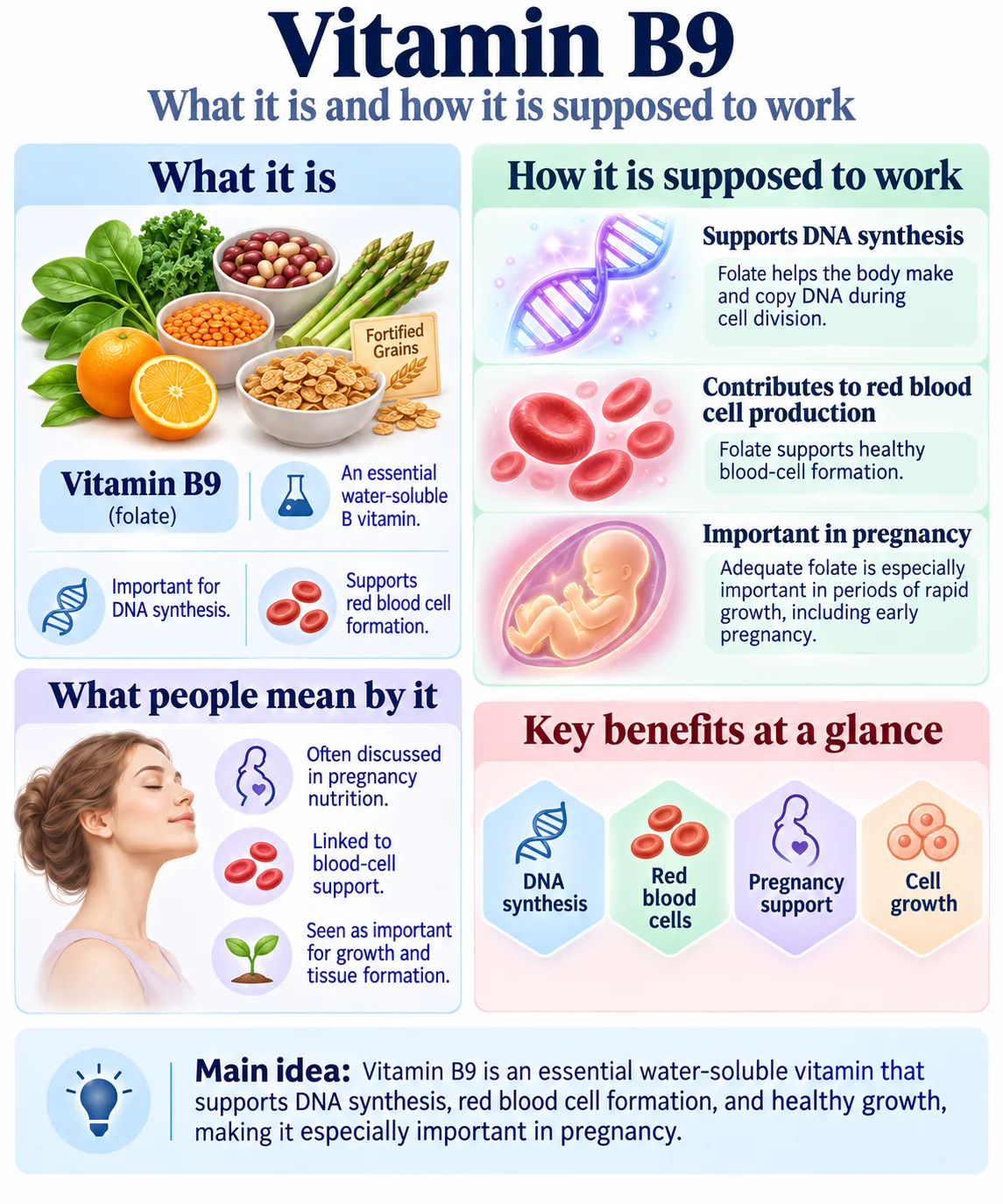
Folate is a water-soluble B vitamin involved in making DNA and red blood cells. It is important during rapid growth, including early pregnancy. Food sources include leafy greens, beans and some fortified grain products. Folic acid is a form used in supplements and some fortified foods; the page explains why pregnancy guidance is specific to folic acid.
Pregnancy and prevention
Folate is important during rapid growth. Taking folic acid before conception and in early pregnancy reduces the risk of neural tube defects. Recommendations specify folic acid and timing; individual needs can differ. Check local guidance and ask a qualified professional rather than assuming a general multivitamin contains the right amount. See also vitamin A and pregnancy.1
For example, the UK NHS recommends 400 micrograms of folic acid daily while trying to conceive, ideally starting three months beforehand, and through the first 12 weeks of pregnancy. If pregnancy has already begun and you have not started, the NHS advises starting as soon as you find out. Some people need a higher prescribed amount because of their medical history or medicines. Ask a clinician promptly about your circumstances; do not stop a prescribed medicine on your own. Guidance differs by country.2
Why starting before pregnancy matters
The neural tube develops into the brain and spinal cord. It closes very early in pregnancy, often before someone knows they are pregnant.5
A 1991 randomised trial studied people who had a previous pregnancy affected by a neural tube defect. The outcome was known for 1,195 pregnancies. A defect occurred in six of 593 assigned folic acid and 21 of 602 not assigned it. This was a higher-risk group studied for recurrence; the figures do not predict everyone’s individual risk. Folic acid reduces the risk of some neural tube defects, not every birth defect.4
The US CDC gives guidance for people who could become pregnant. Needs can differ for those with particular risk factors, so check local guidance and discuss the product and timing with a health professional.5
For someone planning another pregnancy after a previous pregnancy affected by a neural tube defect, US CDC guidance recommends discussing the plan with a clinician and getting 4,000 micrograms (4 mg) of folic acid daily, starting one month before trying to conceive and continuing through the first three months of pregnancy. This is guidance for that specific higher-risk situation, not a general dose for everyone. Recommendations can differ by country and circumstance; do not choose a high dose on your own.5
Does an MTHFR variant mean folic acid cannot be used?
No. MTHFR is a gene involved in processing folate. Common variants, including C677T, can affect how efficiently a related enzyme works, but people with these variants can still process folic acid. The US CDC says common variants are not a reason to avoid it. Very rare variants can have different medical implications and need individual assessment.6
Some supplements contain 5-MTHF, also called methylfolate. It is a form of folate, but raising blood folate and preventing neural tube defects are different outcomes. The US National Institutes of Health says 5-MTHF has not been tested in clinical trials for reducing those defects; folic acid has evidence for prevention. This does not make food folate unimportant or every product interchangeable.7
If you could become pregnant, check local guidance and discuss individual risk factors and your exact prenatal label with a clinician. Do not change prescribed treatment solely because of a genetic test or marketing claim.
Too little, too much and B12
Folate deficiency can cause anaemia. Large amounts of folic acid can correct the anaemia associated with B12 deficiency without correcting nerve damage, potentially delaying recognition of the deficiency. Supplements can also interact with medicines. See vitamin B12 and B12 testing.13
When treating folate-deficiency anaemia, the NHS says clinicians check B12 because folic acid can improve anaemia while an underlying B12 deficiency remains untreated. This is not a reason to stop folic acid recommended or prescribed for pregnancy; discuss B12 concerns with your clinician.8
Some people are prescribed folic acid alongside methotrexate to reduce side effects. For rheumatoid arthritis, UK NHS pharmacy guidance says folic acid is usually taken on a different day from weekly methotrexate. Follow the exact schedule given by the prescribing team; treatment plans differ. Folic acid can also interact with some epilepsy medicines. The plan depends on the medicine and why it is used. Tell your prescriber or pharmacist about all supplements and follow your individual instructions; do not change prescribed medicines yourself.910
The US upper intake level for adults is 1,000 micrograms a day of synthetic folate from supplements and fortified foods; it does not include folate naturally present in foods. This limit is expressed in micrograms, not DFE, and is not a target. It does not apply to higher amounts taken under medical supervision. Do not stop folic acid prescribed or recommended for pregnancy because of this general limit; discuss your product and circumstances with a clinician.1
Further reading
Trusted external resources selected to help explain this page. They open in a new tab.
- Folate: Health Professional Fact Sheet ↗NIH evidence summary on folate, deficiency and interactions.
- Prevention of neural tube defects: results of the Medical Research Council Vitamin Study ↗Randomized recurrence-prevention trial in people with a previously affected pregnancy; its absolute risks are not universal.
- Folic Acid: Facts for Clinicians ↗US public-health guidance; recommendations and individual needs differ by country and risk.
- MTHFR Gene Variant and Folic Acid Facts ↗US public-health guidance on common variants and folic acid.
- Dietary Supplements and Life Stages: Pregnancy — Health Professional Fact Sheet ↗US evidence summary: blood folate measurements and birth-defect outcomes are different questions.
Sources, kept close.
Selected supporting sources; this is not a complete literature review.
- Folate: Health Professional Fact SheetNIH Office of Dietary Supplements · Official nutrition evidence summary
- Pregnancy vitamins and supplementsNHS · Official pregnancy guidance; United Kingdom
- Vitamin B12: Health Professional Fact SheetNIH Office of Dietary Supplements · Official nutrition evidence summary
- Prevention of neural tube defects: results of the Medical Research Council Vitamin StudyThe Lancet · Randomized prevention trial
- Folic Acid: Facts for CliniciansU.S. Centers for Disease Control and Prevention · Public-health guidance
- MTHFR Gene Variant and Folic Acid FactsUS Centers for Disease Control and Prevention · US public-health guidance, updated 16 July 2026
- Dietary Supplements and Life Stages: Pregnancy — Health Professional Fact SheetNIH Office of Dietary Supplements · US pregnancy-nutrition evidence summary
- Vitamin B12 or folate deficiency anaemia: treatmentNHS · UK patient guidance
- Folic acidNational Health Service · UK patient guidance on folic acid and medicines
- Using folic acid with methotrexate in rheumatoid arthritisNHS Specialist Pharmacy Service · UK professional guidance; rheumatoid arthritis