
The answer so far
NAD and NADP are helper forms used in ordinary cell reactions; that explains niacin’s role, not a general promise that high-dose supplements improve energy or health.
Niacin is needed to make the coenzymes NAD and NADP, which participate in energy metabolism and other cellular reactions. Nutritional adequacy and the effects of taking extra supplements are different questions.1
On this page
What the nutrient does
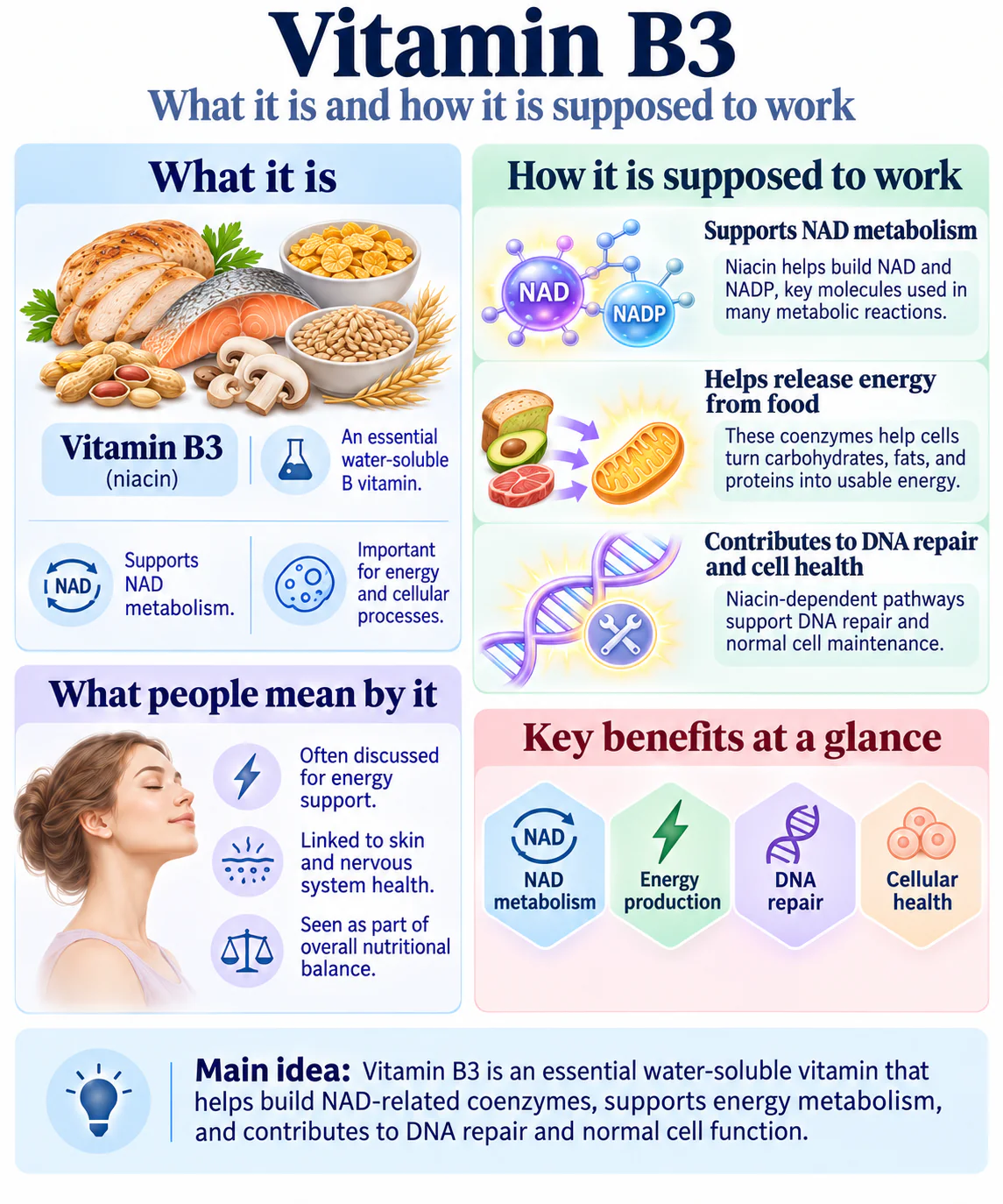
Niacin helps the body make NAD and NADP. These coenzymes help enzymes carry out reactions involved in using energy and other cell functions.1
Read the image summary
Vitamin B3, or niacin, is needed to make NAD and NADP, coenzymes involved in metabolism and cell maintenance. The illustration shows poultry, fish, nuts, grains and mushrooms. Supplement and medicine forms can have different risks, including flushing and liver toxicity at high intakes.
Food and deficiency
Niacin occurs in foods such as poultry, meat, fish, nuts and grains; some foods are fortified. The body can also make some niacin from the amino acid tryptophan. Severe deficiency can cause pellagra, a condition associated with skin changes, diarrhoea and neurological symptoms. Risk depends on diet, absorption and other circumstances. Nicotinic acid and nicotinamide are different supplement forms. Supplemental nicotinic acid can cause flushing; high doses of these forms can have other adverse effects, including liver injury. Prescription treatment is distinct from ordinary dietary intake.1
For context, US recommended dietary allowances for people aged 19 and older are 16 mg niacin equivalents (NE) a day for men and 14 mg NE for women; the values are 18 mg NE during pregnancy and 17 mg NE during breastfeeding. Niacin equivalents include niacin and an estimated contribution from tryptophan. These are dietary reference values, not personal supplement doses; needs and guidance can vary.1
Does raising HDL cholesterol prevent heart attacks?
Not necessarily. In the AIM-HIGH randomised trial, 3,414 people with established cardiovascular disease received extended-release prescription niacin or placebo alongside statin treatment. After an average of three years, niacin improved HDL cholesterol and triglyceride measurements but did not reduce the combined outcome of cardiovascular events. The trial was stopped early for lack of efficacy. This result concerns a particular prescription formulation, population and comparison; it does not mean that vitamin B3 in food is harmful or that all other treatments have the same effect. The study was funded by the US National Heart, Lung, and Blood Institute and Abbott Laboratories.
The combined outcome occurred in 282 of 1,718 people assigned extended-release niacin and 274 of 1,696 assigned placebo. It included events such as heart attack, stroke and certain procedures, not heart attacks alone. To help mask treatment assignment, the placebo tablets contained a small amount of immediate-release niacin intended to mimic flushing. The study did not establish a reduction in this combined outcome; it does not prove the groups had exactly identical risks.216
Does nicotinamide prevent skin cancer?
Nicotinamide, also called niacinamide, is one form of vitamin B3. Evidence for swallowing a defined preparation is not automatically evidence for a skin cream or other forms of niacin. In the Australian ONTRAC trial, 386 adults who had experienced at least two non-melanoma skin cancers in the preceding five years were assigned nicotinamide or placebo for 12 months. The rate of new non-melanoma skin cancers was 23% lower in the nicotinamide group during treatment; this is a relative difference in the rate of cancers, not the percentage of people protected. The trial did not show a continuing benefit in the six months after treatment stopped. It does not establish prevention of melanoma or benefit for everyone. A second Australian trial assigned 158 organ-transplant recipients with previous skin cancers to nicotinamide or placebo and did not find a significant reduction in new keratinocyte cancers; it stopped early because recruitment was slow, so uncertainty remains. Both trials were publicly funded by Australia’s National Health and Medical Research Council. These findings do not replace sun protection, skin checks or prescribed care. People concerned about skin-cancer risk should discuss their history and the specific product with a clinician; this page does not recommend a dose.345
What a supplement claim needs to show
The biological role of NAD does not show that a niacin or NAD-related supplement extends lifespan, improves energy in everyone, or is interchangeable with a prescribed medicine. Compare products using the supplement label guide and discuss personal concerns with a qualified professional. For the distinct evidence on an NAD precursor, see NMN and healthy ageing.1
Why form and supervision matter
Nicotinic acid can cause flushing, while nicotinamide has a different adverse-effect profile. High-dose nicotinic acid can raise blood glucose, and prolonged use, especially some extended-release forms, can cause liver injury. High-dose nicotinamide can also cause adverse effects. Supplements can interact with medicines; a pharmacist or clinician can help interpret a particular product and situation. Do not change prescribed treatment based on a nutrition article.
A product labelled “flush-free” may contain inositol hexanicotinate, a different form from nicotinic acid or nicotinamide. The NIH notes that its absorption varies. A lack of flushing does not establish that products have the same effects, are interchangeable with prescription niacin, or are free of other risks. Check the ingredient and amount with a pharmacist or clinician before changing products.
For healthy people, US guidance sets an upper limit for supplemental niacin of 35 mg a day at age 19 and older and 30 mg a day at ages 14–18. The limit applies to both supplemental nicotinic acid and nicotinamide; it is based on flushing from nicotinic acid, is not a target, and does not apply to medically supervised supplemental treatment. Other authorities may set different limits.1
Further reading
Trusted external resources selected to help explain this page. They open in a new tab.
- Niacin: fact sheet for consumers ↗An official overview; nutrition and medicine recommendations can differ by country.
- Niacin in patients with low HDL cholesterol levels receiving intensive statin therapy ↗A trial in patients with existing cardiovascular disease, not a test of ordinary dietary niacin.
- A Phase 3 Randomized Trial of Nicotinamide for Skin-Cancer Chemoprevention ↗Trial in adults with multiple previous non-melanoma skin cancers.
- Nicotinamide for Skin-Cancer Chemoprevention in Transplant Recipients ↗Trial in transplant recipients; stopped early, with no significant benefit detected.
- Skin Cancer Prevention (PDQ): Health Professional Version ↗US scientific summary, including limits of prevention evidence.
Sources, kept close.
Selected supporting sources; this is not a complete literature review.
- Niacin: Health Professional Fact SheetNIH Office of Dietary Supplements · Official nutrition evidence summary
- Niacin in patients with low HDL cholesterol levels receiving intensive statin therapyNew England Journal of Medicine / PubMed · Randomised placebo-controlled trial; United States and Canada; 2011
- A Phase 3 Randomized Trial of Nicotinamide for Skin-Cancer ChemopreventionNew England Journal of Medicine / PubMed · 2015 Australian randomized trial in 386 adults with previous skin cancers
- Nicotinamide for Skin-Cancer Chemoprevention in Transplant RecipientsNew England Journal of Medicine · 2023 Australian randomized trial in 158 solid-organ transplant recipients
- Skin Cancer Prevention (PDQ): Health Professional VersionUS National Cancer Institute · US scientific evidence summary on skin-cancer prevention
- Extended-release niacin therapy and risk of ischemic stroke in patients with cardiovascular disease: AIM-HIGH trialStroke / PubMed Central · AIM-HIGH trial analysis, 2013