
The answer so far
Vitamin B6 helps the body use nutrients and supports normal nerve function. Taking extra B6 has not been shown to improve mood for everyone. Too much from supplements can damage nerves, so check the amount in all the products you take.1
On this page
- What the nutrient does
- Food and deficiency
- Can extra B6 improve mood or anxiety?
- When several products contain B6
- Does 100% on a label mean a safe maximum?
- Why do vitamin B6 upper limits differ?
- Why are Australian sales rules changing in 2027?
- Recognising a possible problem
- What a supplement claim needs to show
- Sources
Before you read the detail
What it is
A vitamin involved in metabolism and nervous-system function.1
What human evidence shows
Small studies have examined anxiety or depression measures, but do not establish that supplements treat these conditions for everyone.34
Main cautions
Excess supplemental vitamin B6 can cause neuropathy; limits differ by regulator and product.25
Current status
Check total amounts across supplements and follow current local safety guidance.6
What the nutrient does
Vitamin B6 helps with many reactions involving amino acids. It also helps the body make haemoglobin and chemicals that carry signals between nerve cells.1
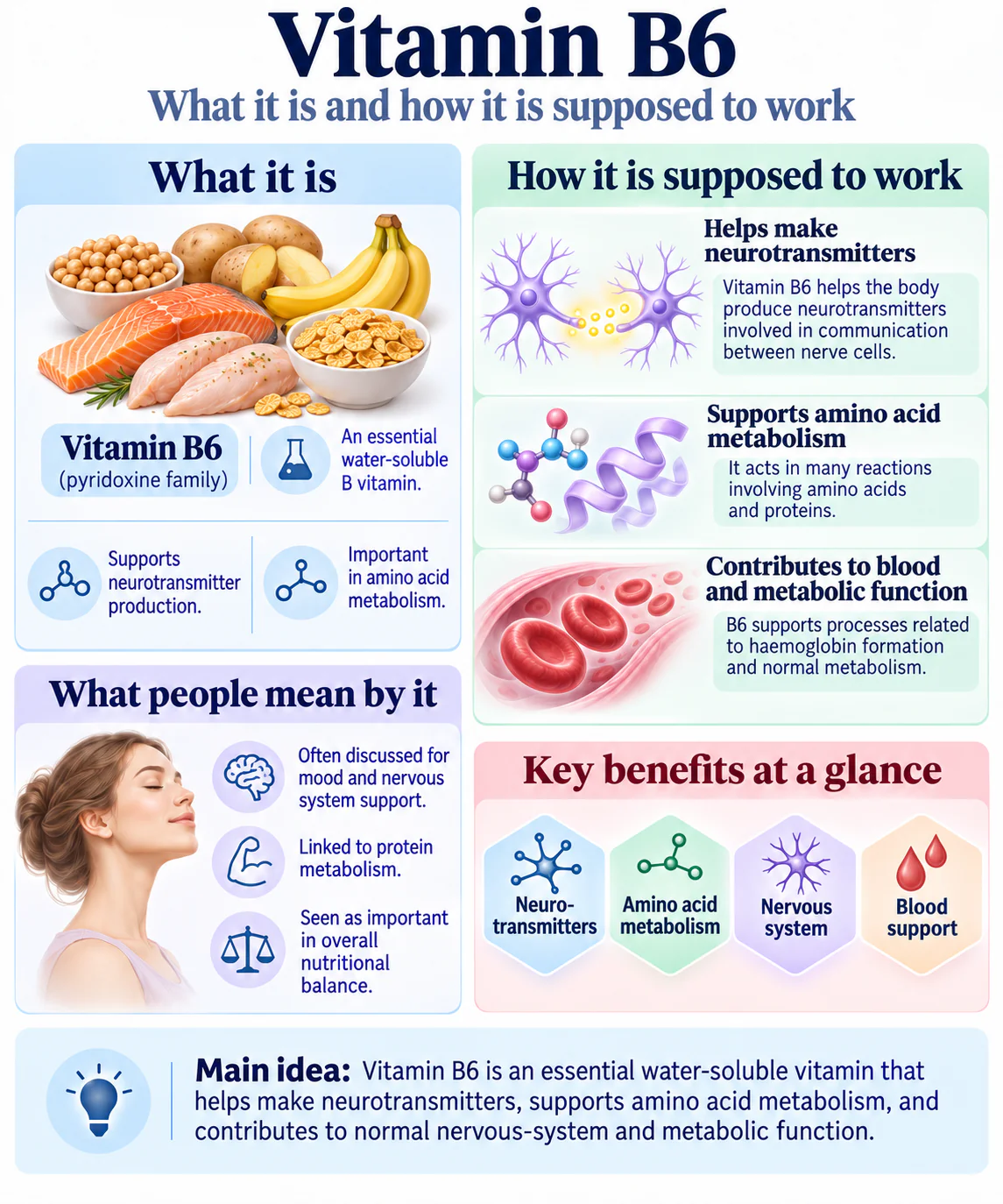
Read the image summary
Vitamin B6 participates in amino acid metabolism, neurotransmitter synthesis and haemoglobin formation. Foods shown include poultry, fish, potatoes, bananas, legumes and fortified cereal. The image mentions mood, but a physiological role does not establish that extra B6 improves mood; excess supplemental B6 can cause nerve damage.
Food and deficiency
B6 is found in foods including poultry, fish, potatoes, some fruit and fortified cereals. Supplements differ in form and amount. Deficiency can cause health problems, but too much supplemental B6 can damage nerves outside the brain and spinal cord. Guidance and limits differ by country, so check the total across your products.1
Can extra B6 improve mood or anxiety?
B6 helps the body make chemicals involved in brain signalling. That does not prove that taking extra B6 treats a mental health condition.
A 2022 randomised study assigned 478 mainly young adults to high-dose B6, B12 or placebo. Anxiety was assessed in 265 people across the groups. Scores fell in both the B6 and placebo groups, but the difference in their changes was not statistically significant on that measure. The roughly one-month study did not establish a lasting benefit or treatment for a diagnosed anxiety disorder.
In 2026, researchers explored data from the same trial using a different questionnaire in a mostly female subset. This was not a separate repeat study. Among 58 people whose starting scores indicated at least mild depressive symptoms, they reported a larger fall in scores with B6; only 19 of those people received B6. They did not find a significant improvement in anxiety or stress scores. This was not a clinical diagnosis or a long-term treatment trial.
The authors called for a larger clinical study planned in advance and noted that antidepressant use was not assessed. A supplement company donated the tablets; the authors reported no conflicts of interest.
These findings call for more research, not a self-treatment plan. The studies used high amounts and cannot settle long-term safety. Too much B6 can damage nerves. Seek professional assessment for persistent anxiety or low mood, and do not replace prescribed treatment with a supplement based on these trials. See stress and mood.34
When several products contain B6
A multivitamin, B-complex or magnesium supplement can each contain B6. Check each label and serving size: some labels name forms such as pyridoxine or pyridoxal-5-phosphate. Australia’s medicines regulator reviewed 32 reports received by August 2022 in which a link between B6 products and peripheral neuropathy was possible; some involved more than one product and some reported intakes of 50 mg a day or less. These reports are signals, not proof that B6 caused every case or a measure of how often harm occurs. The regulator says susceptibility varies and no minimum dose or duration has been established. Do not treat 50 mg, or the presence or absence of a label warning, as a personal safety threshold.
In that historical set of 32 reports, 21 involved a reported daily amount of 50 mg or less and nine involved more than one B6-containing medicine. These categories can overlap. Some people said they had not realised a magnesium product contained B6. The reports were selected because a reaction was suspected; without knowing all users and exposures, they cannot tell us the likelihood of neuropathy at any amount.
For example, suppose one label lists 4 mg of B6 per serving of two tablets, and another lists 3 mg per one capsule. Taking one tablet of the first and one capsule of the second would provide 2 mg plus 3 mg, or 5 mg of B6 from those products. This fictional calculation excludes food and other sources; it is not a recommended amount or a guarantee of safety. Check whether the label reports an amount per tablet, capsule or serving, and show the complete list to a pharmacist if unsure.
The Australian regulator recorded 250 reports with specified neuropathy-related terms in its database by 31 October 2025. This broader set is defined differently from the 32 selected reports above: the counts cannot simply be subtracted to show new cases. A report does not by itself prove B6 caused a problem or tell us how often it occurs. Some magnesium products also contain B6; compare all ingredients using the supplement-label guide.216
- First product4 mg per 2 tablets; one tablet provides 2 mg.
- Second product3 mg per capsule; one capsule provides 3 mg.
- Together2 mg + 3 mg = 5 mg from these two products.
Does 100% on a label mean a safe maximum?
No. A label percentage compares one serving with a reference value; it is not your personal safety limit. On US labels, 100% of the daily value for B6 is 1.7 mg for adults and children aged four and over. The EU adult nutrient reference value is 1.4 mg. These are label references, not the upper intake levels discussed below. Values can differ by country and age group, so check the serving size too.89
Why do vitamin B6 upper limits differ?
A tolerable upper intake level is a reference for usual daily intake across a population. It is not a recommended amount or a guarantee of safety for one person. It includes B6 from food and supplements.
In its 2023 scientific opinion, the European Food Safety Authority (EFSA) set an adult upper level of 12 mg a day, including during pregnancy and breastfeeding, based on its assessment of nerve-injury evidence. Children’s limits are lower and vary by age. EFSA’s general dietary-reference-values page says 12.5 mg, while the scientific opinion says the adult figure was rounded down to 12 mg; its 2024 summary also lists 12 mg. The topic page does not explain the difference. This page uses the scientific opinion’s figure.
The US National Institutes of Health lists an adult upper level of 100 mg a day from an earlier US Food and Nutrition Board assessment. These figures reflect different evidence assessments and assumptions. Neither is a personal target or a sharp line between safe and harmful. Australian adverse-event reports also cannot establish an individual threshold.
An upper intake level differs from a legal product limit and from prescribed treatment, which needs clinical supervision. If several products contain B6, take the labels to a pharmacist or clinician for help understanding the total.5121011
Why are Australian sales rules changing in 2027?
Australia’s medicines regulator says that from 1 June 2027, oral products with more than 50 mg and up to 200 mg of B6 per manufacturer-recommended daily dose will be pharmacist-only. Products at or below 50 mg remain generally available; those above 200 mg remain prescription medicines. These are Australian supply categories, not personal safety thresholds or rules for other countries.
A separate 2026 consultation proposes labelling changes for specified B6 ingredients. A proposal is not a final rule. Recheck the regulator’s current instructions before relying on them.67
Recognising a possible problem
Peripheral neuropathy means damage to nerves outside the brain and spinal cord. Tingling, burning or numbness, often in the hands or feet, can have several causes. Australia’s regulator advises people with these symptoms who take B6 products to stop the product and seek medical advice promptly. If B6 is part of prescribed treatment, contact the prescriber promptly for advice about that treatment.
Bring the containers or a list of all medicines and supplements. Symptoms alone cannot establish their cause. For different questions, see early ARA-290 research in nerve pain and B6, B12 and nerve symptoms; the substances and evidence are not interchangeable.2
What a supplement claim needs to show
B6 has roles in nervous-system function, but this does not mean that taking more will improve mood, sleep or energy in a person who already has adequate status. Compare products using the supplement label guide and discuss personal concerns with a qualified professional.1
Further reading
Trusted external resources selected to help explain this page. They open in a new tab.
- Vitamin B6: Health Professional Fact Sheet ↗US scientific overview of food sources, deficiency, supplementation and harms; not a personal assessment.
- Peripheral neuropathy with supplementary vitamin B6 (pyridoxine) ↗Australian regulator safety review of spontaneous reports; individual causation and incidence cannot be established from these reports alone.
- Vitamin B6 and self-reported anxiety: 2022 study ↗Anxiety data came from a subset; short-term findings are not proof of treatment for diagnosed anxiety.
- Vitamin B6 and depressive symptoms: 2026 exploratory study ↗Small symptom-defined subgroup; short follow-up and further clinical replication needed.
Sources, kept close.
Selected supporting sources; this is not a complete literature review.
- Vitamin B6: Health Professional Fact SheetNIH Office of Dietary Supplements · Official nutrition evidence summary
- Peripheral neuropathy with supplementary vitamin B6 (pyridoxine)Australian Therapeutic Goods Administration · Regulator safety update and adverse-event review
- High-dose Vitamin B6 supplementation reduces anxiety and strengthens visual surround suppressionHuman Psychopharmacology · Primary randomized controlled study, 2022
- High Dose Vitamin B6 Reduces Depression SymptomsDepression and Anxiety / Wiley · Primary exploratory randomized study, 2026
- Scientific opinion on the tolerable upper intake level for vitamin B6European Food Safety Authority · Scientific risk assessment
- Medicines containing vitamin B6: safety and scheduling changesAustralian Therapeutic Goods Administration · Regulator safety and scheduling update
- Consultation on changes to permissible vitamin B6 ingredientsAustralian Therapeutic Goods Administration · Regulator consultation
- Daily Value on the Nutrition and Supplement Facts LabelsUS Food and Drug Administration · Official food-label reference
- Regulation (EU) No 1169/2011, Annex XIII: nutrient reference valuesEuropean Union · Food labelling regulation
- Dietary reference valuesEuropean Food Safety Authority · EFSA dietary reference values topic page
- Summary of Tolerable Upper Intake Levels: vitamins, June 2024European Food Safety Authority · EFSA upper-intake summary table, 2024