
The answer so far
FAD and FMN are helper forms that let enzymes carry out normal energy-related reactions. That explains why riboflavin matters; it does not show that extra B2 improves energy for everyone.
Riboflavin is a component of the coenzymes FAD and FMN, which participate in energy metabolism and normal cell function. Nutritional adequacy and the effects of taking extra supplements are different questions.1
On this page
What the nutrient does
Riboflavin forms part of two enzyme helpers, called the coenzymes FAD and FMN. They help cells use energy and function normally.1
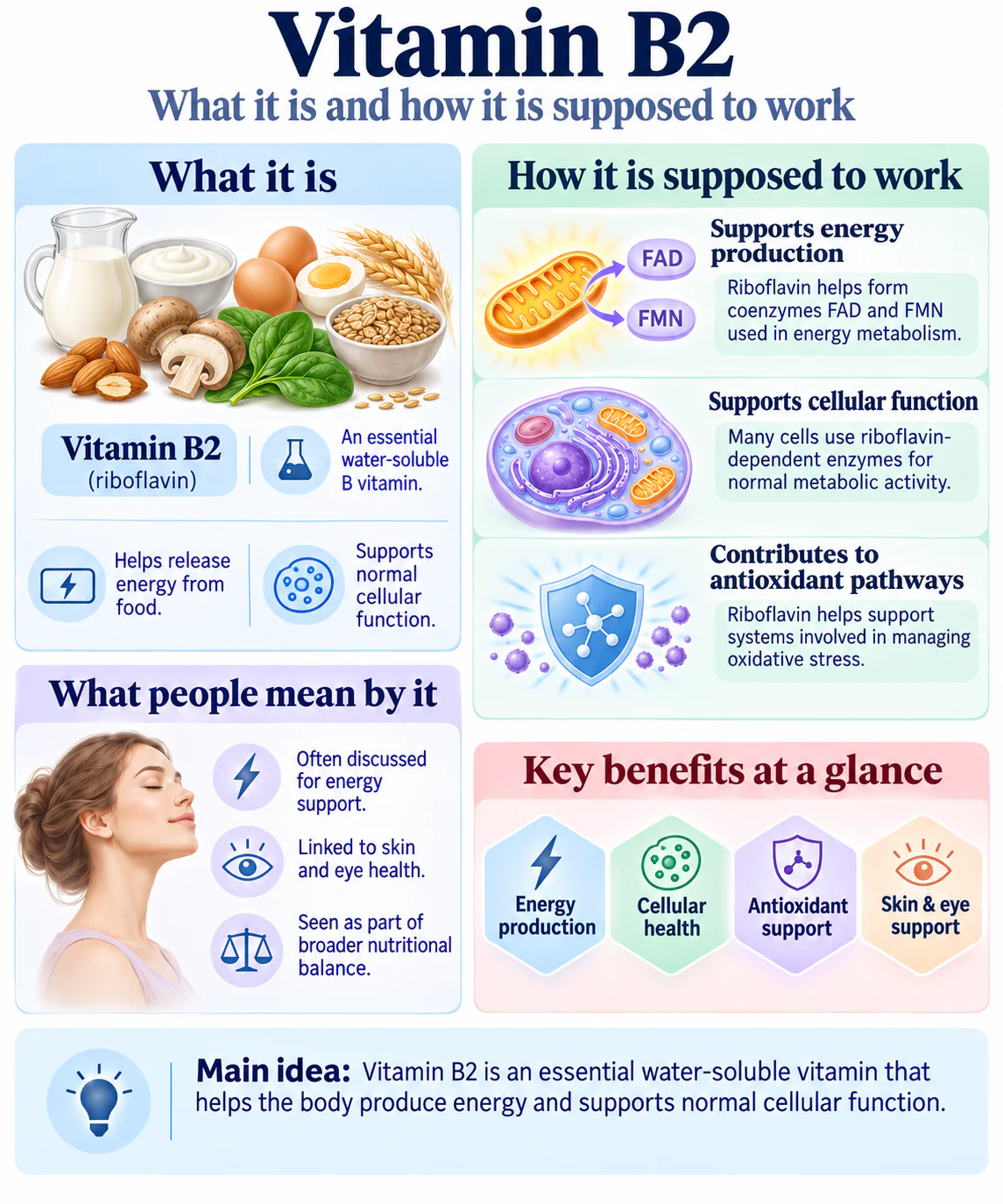
Read the image summary
Vitamin B2, or riboflavin, is used to make the coenzymes FAD and FMN, which participate in energy metabolism and normal cell function. The image shows dairy, eggs, mushrooms, greens, grains and nuts. An antioxidant pathway is not proof that a supplement prevents disease.
Food and deficiency
Riboflavin occurs in foods including dairy, eggs, meat, some vegetables and fortified grains. The amounts in a meal depend on the foods and preparation. Low intake or absorption can contribute to deficiency; some people with limited diets or particular medical conditions have greater risk. Individual diagnosis requires appropriate assessment.
NIH identifies vegetarian athletes, people who are vegan or consume little dairy, and people with rare riboflavin-transporter deficiency among groups at greater risk of inadequate intake or status. Pregnancy and breastfeeding can also change needs. These factors do not establish that an individual is deficient.
For dietary context, US recommendations for adults are 1.3 mg daily for men and 1.1 mg for women, and 1.4 mg during pregnancy or 1.6 mg while breastfeeding. These are total-intake references, not supplement doses. US authorities did not set an upper limit because of limited adverse-effect evidence; that does not prove very high intakes are risk-free. Discuss high-dose products with a clinician.1
Can vitamin B2 help prevent migraine?
Some evidence suggests riboflavin may reduce how often migraine attacks occur, but more rigorous research is needed. In a 1998 placebo-controlled trial, 55 people with migraine were assigned riboflavin at 400 mg a day or placebo for three months; this describes the study, not a recommended dose. A reduction of at least half in headache days was reported in 59% of the riboflavin group versus 15% of the placebo group. This small, short study does not predict an individual result or establish that every supplement works; it studied prevention, not relief during an attack. The amount used was much higher than ordinary nutritional needs. A clinician can help assess persistent headaches, discuss preventive options and consider other medicines and individual circumstances. For a separate supplement and its trial evidence, see CoQ10 and migraine.23
What about children? Results are mixed. In a 2008 placebo-controlled trial of 48 children, at least a halving of migraine attacks was reported for 12 of 27 given riboflavin and 14 of 21 given placebo; the difference was not statistically significant. In a separate 2018 trial, 90 children were assigned to one of two riboflavin groups or placebo. After 12 weeks, the higher-amount group had a greater reduction in attack frequency and duration than placebo, but not in pain intensity. The studies were small and used different methods; the latter used assumptions for missing follow-up data. Neither can predict an individual child’s response or establish long-term safety. Discuss a child’s recurring headaches and any supplement with their clinician.45
A suddenly extremely painful headache, new weakness on one side or difficulty speaking needs emergency help immediately. Do not assume these symptoms are a usual migraine or wait for a supplement to work.6
What a supplement claim needs to show
Riboflavin is studied for several health questions, including migraine prevention, but a normal cellular role does not prove that taking an over-the-counter supplement prevents disease. Compare products using the supplement label guide and discuss personal concerns with a qualified professional.1
Further reading
Trusted external resources selected to help explain this page. They open in a new tab.
- Riboflavin for migraine prevention: randomized trial ↗Small 1998 study over three months; it assessed prevention, not treatment of an attack.
- Headaches: what you need to know ↗US official overview; more rigorous research is needed.
Sources, kept close.
Selected supporting sources; this is not a complete literature review.
- Riboflavin: Health Professional Fact SheetNIH Office of Dietary Supplements · Official nutrition evidence summary
- Effectiveness of high-dose riboflavin in migraine prophylaxis: a randomized controlled trialNeurology / PubMed · 1998 randomized placebo-controlled clinical trial; Belgium
- Headaches: What You Need To KnowNational Center for Complementary and Integrative Health · US official evidence summary
- High-dose riboflavin for migraine prophylaxis in children: a double-blind, randomized, placebo-controlled trialJournal of Child Neurology / PubMed · 2008 randomized trial; 48 children; small sample
- Prophylactic effect of riboflavin on pediatric migraine: a randomized, double-blind, placebo-controlled trialElectronic Physician / PubMed · 2018 randomized trial; 90 children; missing follow-up assumptions
- MigraineNHS · UK patient guidance